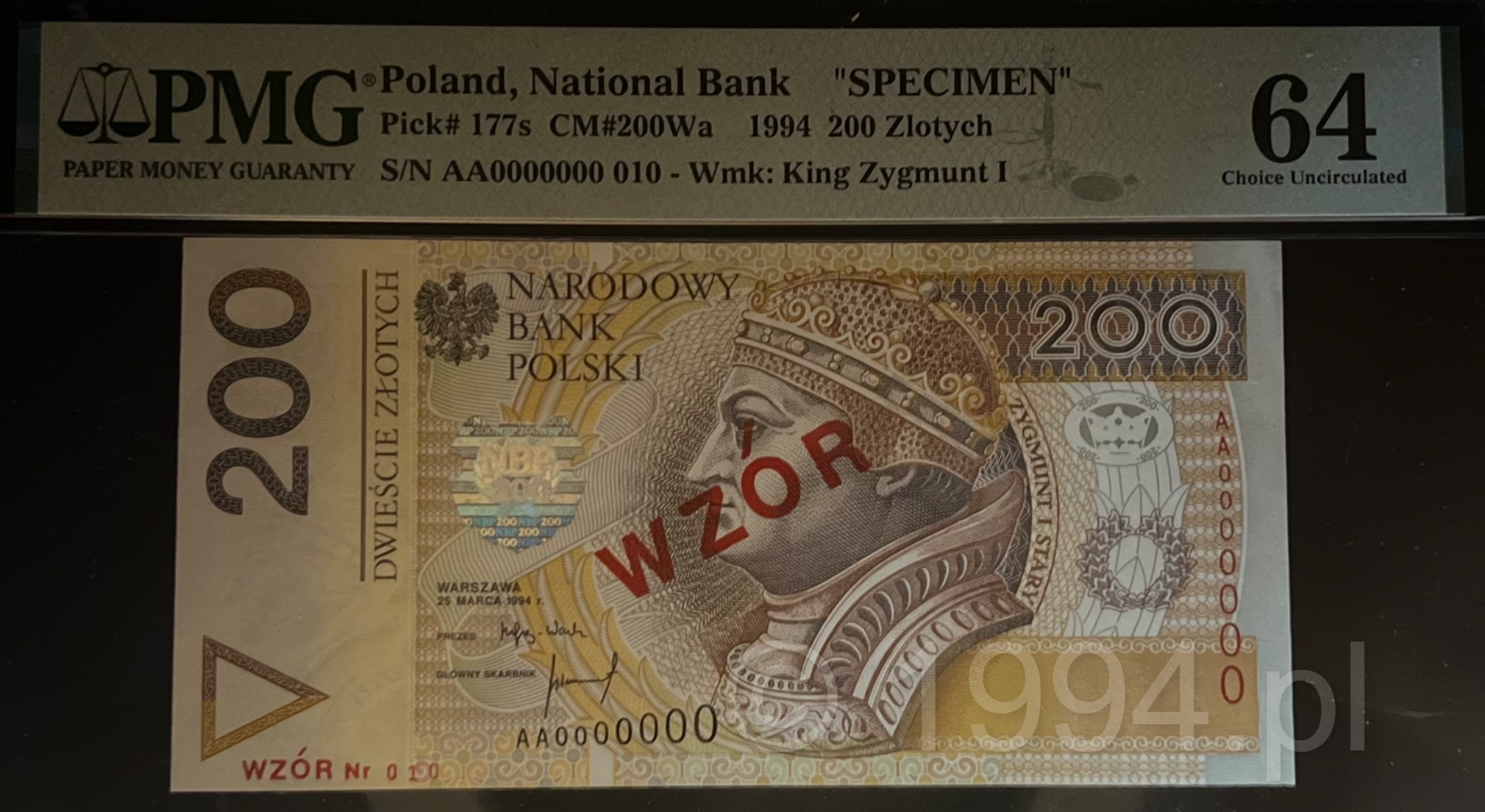
Poland 1994 - 200 Zlotych, Narodowy Bank Polski WZÓR Specimen Number 010 (Pick 177s)
This AA0000000, WZÓR No. 010 example completes the full five-denomination matching-number WZÓR 010 set preserved in this collection. Read more →
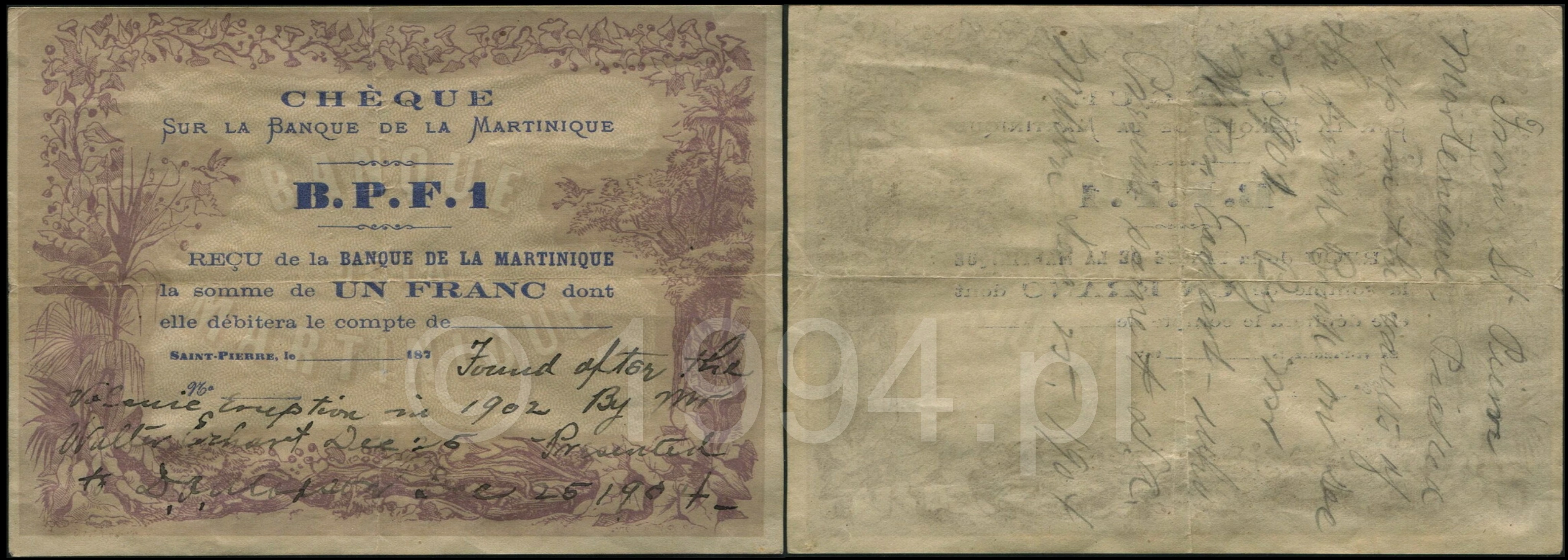
As a surviving unissued example, this cheque serves as a documentary artifact of colonial banking mechanics rather than a monetary substitute. Pick P.5A is infrequently encountered, and examples in fully unused condition are especially scarce. The piece occupies a specialized niche within French colonial numismatics, valued for its institutional context, documentary clarity, and direct association with Martinique’s pre-1902 financial history. Read more →
The printed face follows the established Banque de la Martinique cheque format, bearing the heading “Chèque sur la Banque de la Martinique,” internal control marking “B.P.F. 1,” and a printed acknowledgment of receipt for the sum of one franc, to be debited from the account of a named holder. The place of issue is Saint-Pierre, with a printed year line left incomplete, consistent with cheque forms intended to be dated at the time of use. Ornamental engraved borders composed of tropical flora frame the document, reflecting French metropolitan engraving conventions adapted for colonial financial instruments. Printer imprints at the lower margins attribute production to Claverie et Fils, with engraved elements credited to Reschérer. Read more →
Counterfeiting became a major problem for the apolice system. Common paper, relatively simple designs, and handmade printing plates made imitation possible. A Treasury record from 1819 listed 42 false apolices worth 552,600 reis; three were altered genuine pieces, while the others were printed forgeries. By 1821, official records listed counterfeit apolices valued at more than 477 million reis. The serial, counterfoil, embossed devices, and successive reverse stamps all belonged to the system of controls surrounding these obligations. Read more →
This example is exceptional for its state of preservation. Most contemporary counterfeits survive today only in heavily worn condition, having circulated extensively and often been destroyed once detected. By contrast, this note remains in Choice Uncirculated condition with Exceptional Paper Quality. The EPQ designation confirms original paper integrity, intact fibers, and the absence of chemical processing or restoration, conditions rarely encountered in circulating forgeries of this era. Read more →
As the presently unique documented face proof of Pick S239p, this piece occupies a reference-level position within the study of Banco de Londres y Rio de la Plata banknote production. It preserves the approved engraved face of the 10 Pesos issue at a critical stage of manufacture and provides a direct record of nineteenth-century Bradbury Wilkinson security printing for Uruguay. Its type-level uniqueness, technical function, retained counterfoil, and connection to the later 1883 10 Pesos specimen establish it as an R9 Extremely Rare museum-grade artifact within the history of Uruguayan private-bank paper money. Read more →
The engraved certificate acknowledges indebtedness to bearer in the sum of Five Dollars and is transferable by delivery. It bears interest at the rate of four percent per annum from the date of issue until redemption, with redemption tied to the payment of taxes or other indebtedness to the issuing city, as provided by the Board of Commissioners. The legal language is deliberately broad and non-specific, designed to satisfy statutory requirements across multiple jurisdictions while remaining adaptable to local authorization. Read more →
Unlike informal emergency substitutes or privately issued local notes, this instrument was grounded in a defined statutory and administrative framework. The engraved certificate explicitly states that the County of Atlantic was holding nine thousand one hundred eighty-five dollars in obligations of the Borough of Longport, New Jersey, received on account of the nineteen thirty-three state school tax. These obligations were pledged as security for payment to bearer, embedding the scrip within an intergovernmental structure linking municipal debt, county administration, and state-mandated education funding. Read more →
This specimen represents an official municipal scrip issued by the Borough of Palmyra, Burlington County, New Jersey, Series of 1933, and denominated Five Dollars. It originates from the most acute phase of the Great Depression, when local governments faced severe liquidity shortages and were compelled to issue interest-bearing scrip to meet ordinary municipal obligations in the absence of sufficient circulating cash. Read more →
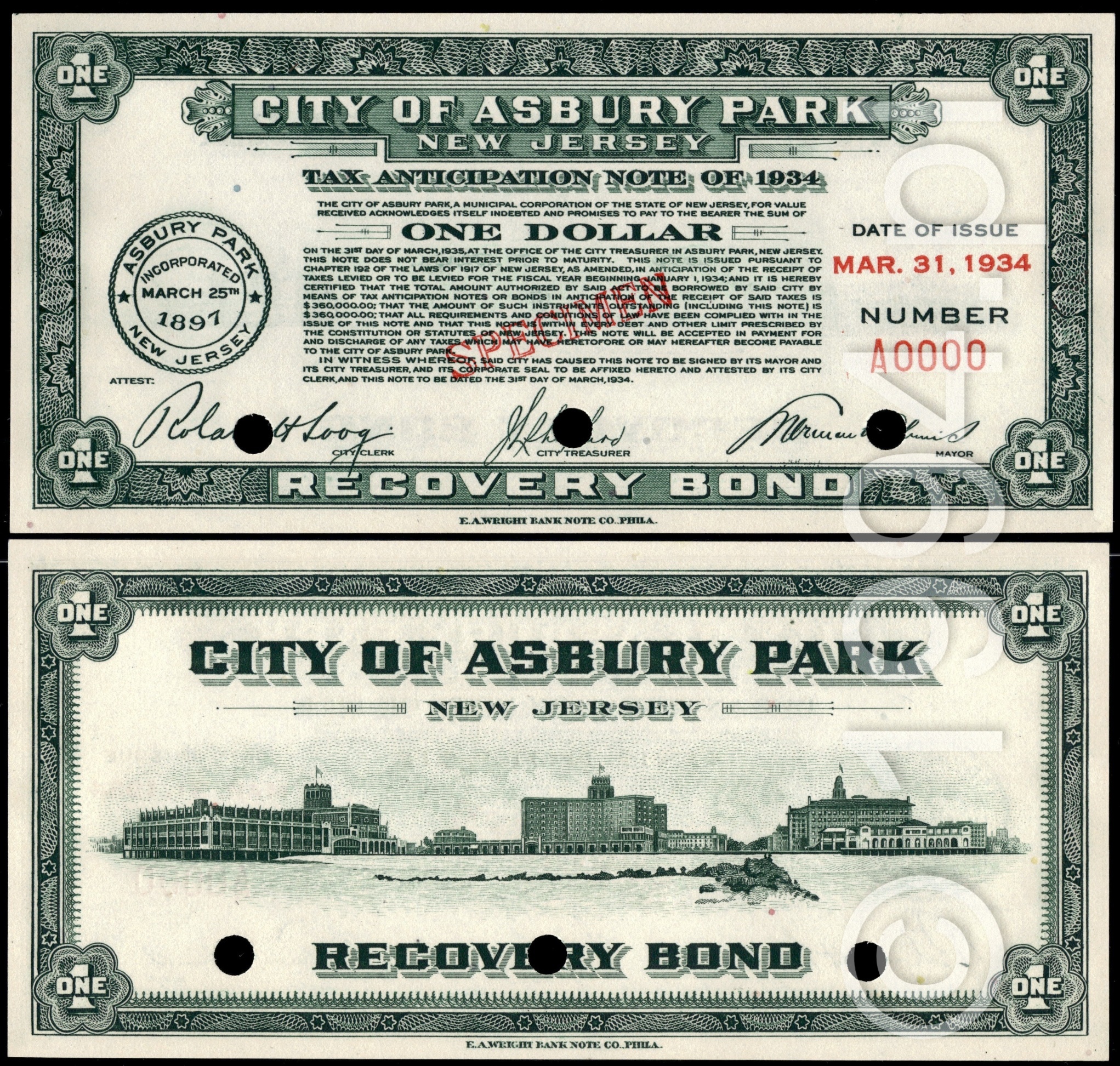
This example is a true printer-issued specimen, identified by the serial number A 0000 and the overprinted word SPECIMEN. It was not intended for circulation and was produced solely for authorization, approval, or archival reference during the establishment or continuation of the issue. The reverse is dominated by a large, complex radial guilloche medallion, a professional anti-counterfeiting feature consistent with established security printing standards rather than local or improvised production. Read more →
The engraved legal text states that the City of Asbury Park, a municipal corporation of the State of New Jersey, for value received acknowledges itself indebted and promises to pay to bearer the sum of One Dollar. The note was issued at the office of the City Treasurer and does not bear interest prior to maturity, consistent with its intended use as a rapidly redeemable anticipation instrument. It is expressly acceptable in payment for and discharge of any taxes thereafter payable to the city, reinforcing its dual function as both a municipal obligation and a fiscal settlement medium. Read more →
No other specimen example of this City of Asbury Park Five Dollars Tax Anticipation Note of 1934 is documented in institutional collections, auction records, certification census data, or standard reference literature. Based strictly on observed and recorded evidence, this piece stands as a unique surviving specimen and serves as a definitive documentary artifact of Depression-era municipal finance and recovery policy in the United States. Read more →