Collection PL

About 1994.pl

U.S. paper money embodies nearly two centuries of continuous change—social, technological, and institutional. From the 1830s onward, local banks, states, and private printers created an extraordinary visual record of America’s financial experimentation. Early proofs and scrips by firms such as Underwood, Bald, Spencer & Hufty or Rawdon, Wright, Hatch & Edson predate national unity, their engraved portraits and ornaments defining the first true American style of intaglio currency art.

The Civil War and Reconstruction introduced federal control and unprecedented production scale. The 1863 National Banking Act organized thousands of chartered banks whose notes—each bearing its town and charter number—documented regional enterprise from Massachusetts to Kansas. Large-size and small-size Nationals illustrate the transformation from local credit to federally secured obligations, while fractional and state issues like South Carolina’s 1872 Revenue Bonds record fiscal necessity in turbulent times.

The twentieth century shifted focus to standardization and innovation. The Series of 1914 Federal Reserve Notes established centralized issue under the new Reserve System; later small-size redesigns of 1928 codified modern U.S. dimensions. Experimental pieces—Giori press trials, C.O.P.E. calibration sheets, ABNC specimen notes—reveal the industry’s technical core, where anti-counterfeit design met production research. By mid-century, the Bureau of Engraving and Printing had refined color, security threads, and watermark technology into global benchmarks.

Spanning 1830 to 2003, this section captures the United States as engraver, innovator, and issuer—an unbroken lineage from independent presses to the Bureau’s modern laboratories of paper and ink.

60 results · Page 1 of 5
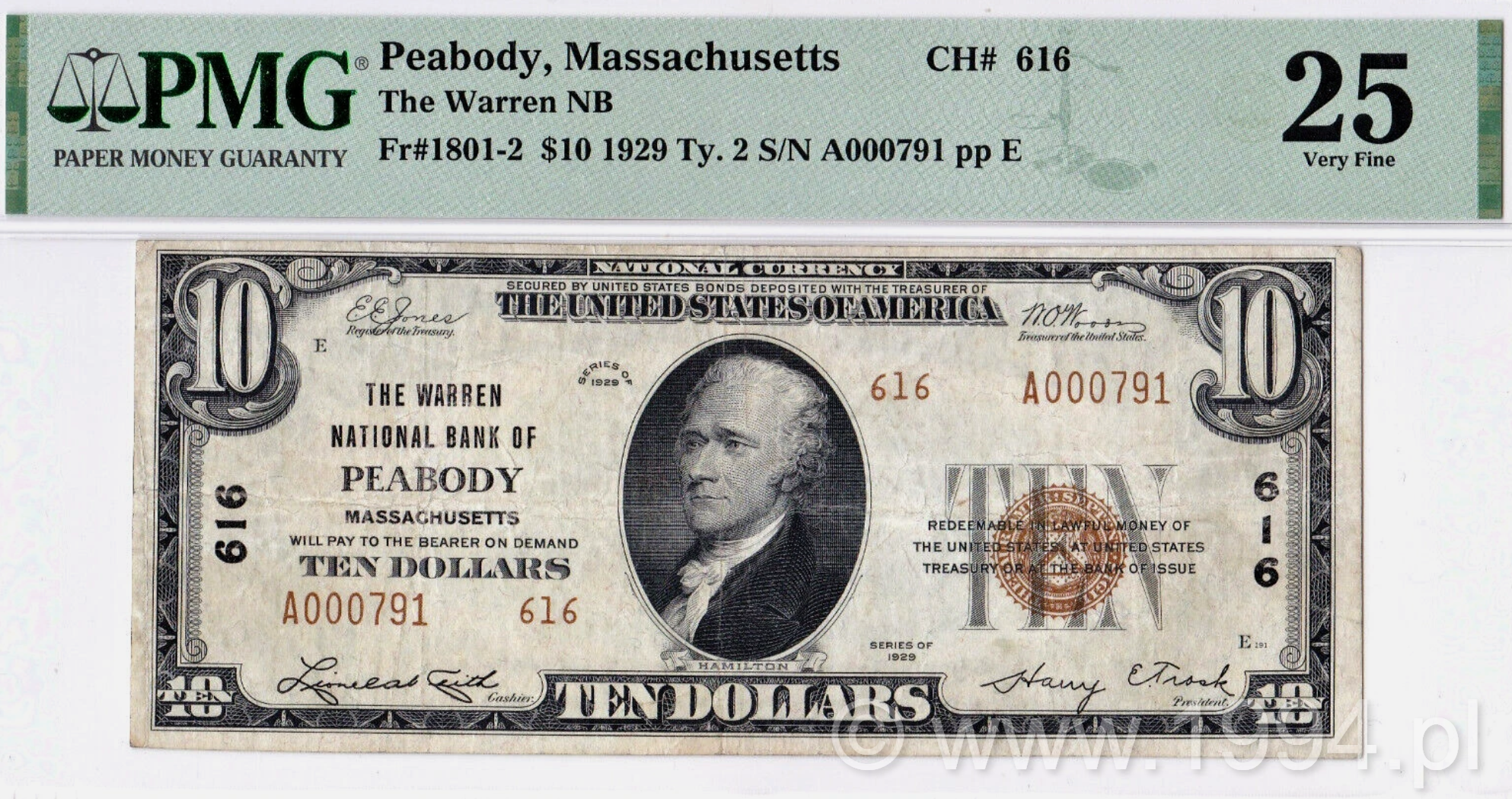
United States 1929 The Warren National Bank of Peabody Massachusetts 10 Dollars Type 2 National Bank Note, Charter 616, Friedberg 1801-2, serial number A000791, plate position E, brown seal National Currency note certified PMG 25 Very Fine.

United States 1929 - The Warren National Bank of Peabody, Massachusetts 10 Dollars Type 2 National Bank Note, Charter 616 (Fr. 1801-2)

As a surviving 1929 Type 2 National Bank Note from Peabody, Massachusetts, this piece is a focused example of small-size National Currency from the final phase of the National Bank Note system. Its importance rests in the combination of federal currency design, local bank identification, Charter 616 attribution, Peabody industrial context, and certified preservation in PMG 25 Very Fine condition. Read more →

United StatesNational Bank Note192910 DollarsPMG 25 Very Fine National Bank NoteNational CurrencySmall Size National Bank NoteSeries of 19291929 Type 2Type 2 National Bank Note10 DollarsTen DollarsBrown SealIssued NoteFederal CurrencyLocal BanknoteCharter Bank NoteCharter Number NoteThe Warren National Bank of PeabodyWarren National BankPeabody MassachusettsPeabodyMassachusettsEssex CountyCharter 616CH 616Serial A000791Plate Position EAlexander HamiltonHamilton PortraitBureau of Engraving and PrintingBEPUnited States TreasuryNational Banking EraSmall Size Currency1930s CurrencyPeabody Leather IndustryLeather IndustryNew England BankingMassachusetts Banking HistoryLocal Banking HistoryIndustrial Banking HistoryAmerican Financial HistoryFriedberg 1801-2Fr. 1801-2PMG 25 Very FinePMG 25 VFVery FineCertified NoteUnited StatesUnited States 1929
Held
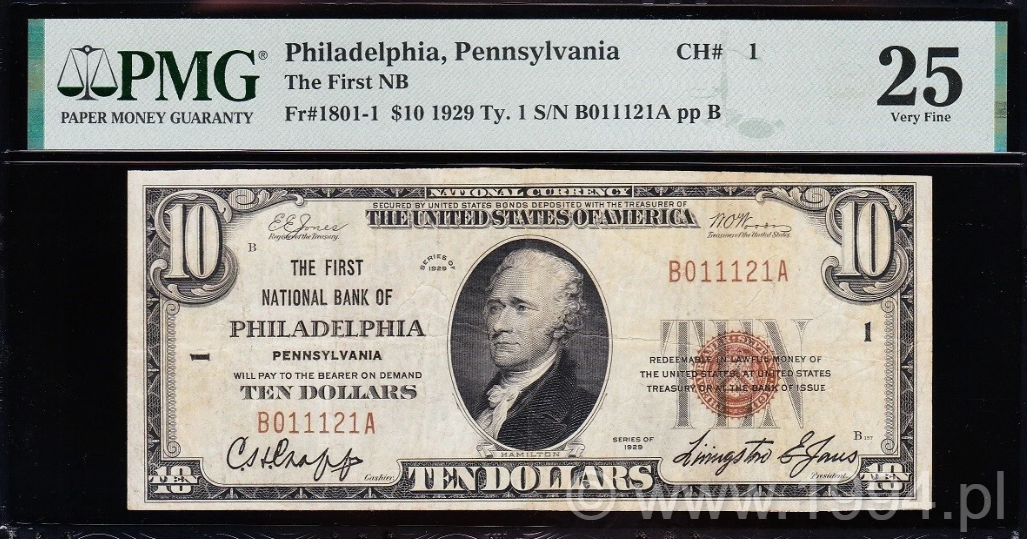
United States 1929 Type 1 - 10 Dollars National Bank Note The First National Bank of Philadelphia Pennsylvania Fr 1801-1 Charter 1 PMG 25 Very Fine

United States 1929 Type 1 - 10 Dollars National Bank Note - The First National Bank of Philadelphia, Pennsylvania Charter 1 (Fr. 1801-1)

The First National Bank of Philadelphia holds Charter 1, the very first federal national bank charter issued under the National Banking Act of 1863. Granted on June 20, 1863, it became the prototype for a new system that tied local banknotes to United States bonds and standardized design, redemption, and supervision across the country. Read more →

United StatesNational Bank Note192910 DollarsPMG 25 Very Fine 10 DollarsNational Bank NoteIssued NoteType 1PhiladelphiaPennsylvaniaCharter 1Low CharterHamilton1929PMG 25 VFFederal Banking History
Held
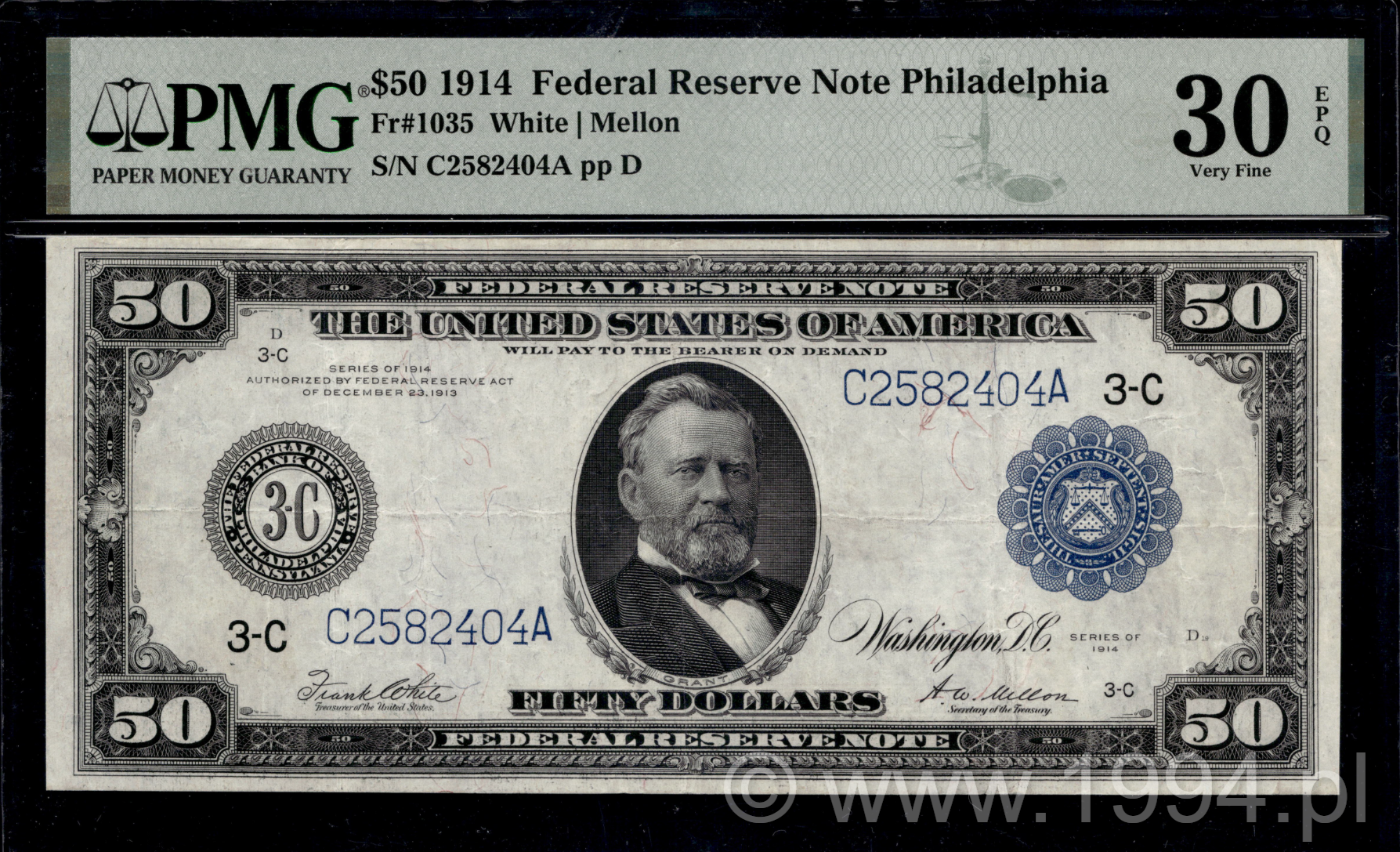
United States 1914 50 Dollars Federal Reserve Note Philadelphia District Fr 1035 White Mellon PMG 30 EPQ

United States 1914 – 50 Dollars Federal Reserve Note – Philadelphia District White | Mellon (Fr.1035)

Printed by the Bureau of Engraving and Printing, the note bears the signature pair of Treasury officials White and Mellon. Its large-size layout measures approximately 7.4 by 3.1 inches, engraved with elaborate guilloche and shaded lathework that define the artistry of early twentieth-century federal issues. The Friedberg reference number 1035 identifies the Philadelphia district variety, distinguished by its blue Treasury seal and serials beginning with the prefix C. Read more →

United StatesFederal Reserve Note191450 DollarsPMG 30 EPQ Very Fine 50 DollarsFederal Reserve NoteIssued NotePhiladelphiaFr 10351914 Series1914Large SizeGrantPanama ReverseUnited StatesPMG 30 EPQ
Held
United States 1948 Republican National Convention engraved admission ticket with Benjamin Franklin portrait, Gate 2 Section J Row P Seat 13, Liberty Bell reverse, E.A. Wright Bank Note Co. Philadelphia

United States 1948 - Republican National Convention Ticket Philadelphia, E.A. Wright Bank Note Co.

Physically, the ticket consists of a main admission panel and two detachable coupons for sequential sessions, joined by precision-drilled perforations. Each coupon repeats the engraved border and typography, demonstrating Wright’s mastery of perforated securities-a process originally perfected for multi-part bank drafts and coupon bonds. The engraving is double-sided: on the reverse, a deeply inked green composition centers the Liberty Bell within interlaced medallions, accompanied by subsidiary guilloche panels carrying Wright’s imprint. This 'banknote back' echoes the anti-counterfeiting devices of U.S. currency and transforms a temporary event pass into a miniature work of applied engraving art. Read more →

United StatesConvention Ticket1948Admission TicketUncirculated United StatesRepublican National Convention1948Political AmericanaE.A. Wright Bank Note Co.Red OverprintBenjamin FranklinLiberty BellPhiladelphiaEngraved Ticket
Held
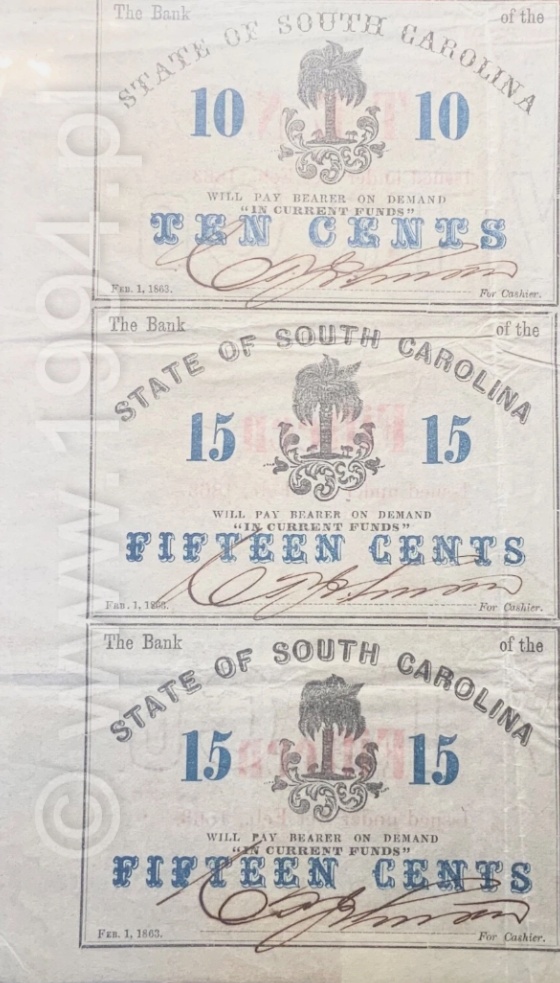
1863 Bank of the State of South Carolina uncut sheet with one 10c and two 15c notes

United States 1863 - Bank of the State of South Carolina 10c and 15c Uncut Sheet of 3

Uncut vertical sheet of three fractional notes from the Bank of the State of South Carolina in Charleston, dated February 1, 1863. The pane contains one 10 cents and two 15 cents notes. These pieces were issued during the Civil War coin shortage under the Act of February 1863 and were payable to bearer in current funds rather than in coin. Read more →

United StatesUncut Sheet186310c and 15c (Sheet of 3)Raw (VF est.) Civil WarObsolete CurrencyFractionalSouth CarolinaBank of the State of South CarolinaUncut Sheet10 cents15 centsWalker Evans and Cogswell1863
Held
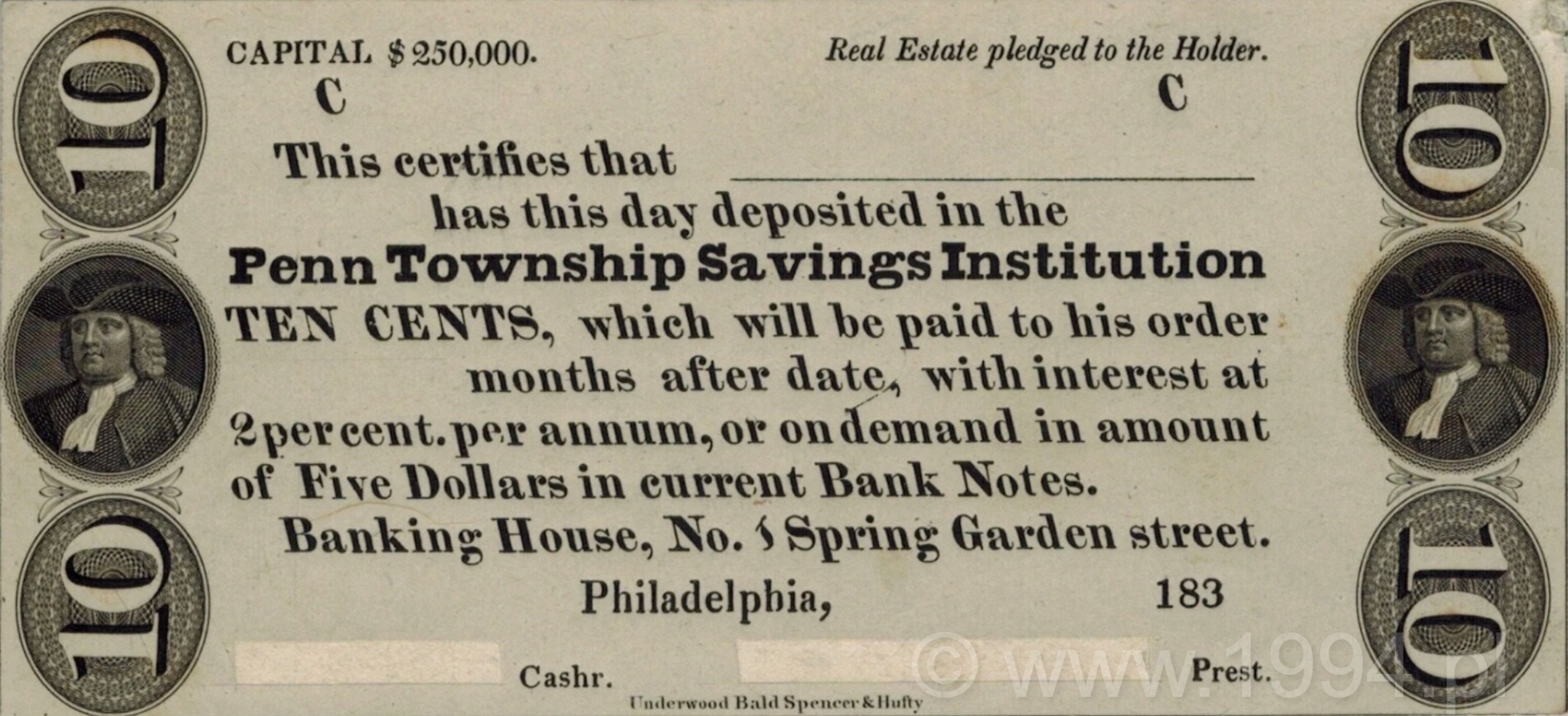
1830s Penn Township Savings Institution 10 Cents proof deposit certificate engraved by Underwood Bald Spencer & Hufty of Philadelphia

United States 1830s - Pennsylvania, Philadelphia - Penn Township Savings Institution 10 Cents Proof (Unlisted)

As a historical artifact, the piece documents the intersection of early American banking, working-class savings culture, and the development of security printing in the decades before the Civil War. Read more →

United StatesObsolete Proof Note183010 CentsProof (Unissued) Obsolete ProofPick UnlistedUnlistedSavings Deposit CertificateFractional Savings NoteEarly Micro-SavingsMortgage Backed DepositWilliam Penn PortraitPenn Township Savings InstitutionPhiladelphia Banking HistoryMutual Savings BankUnderwood Bald Spencer & HuftyAmerican Security PrintingPre-American Bank Note Company Engraving19th Century EngravingUnited StatesPennsylvaniaPhiladelphia1830s10 CentsObsolete CurrencyEarly American BankingMuseum Grade
Held
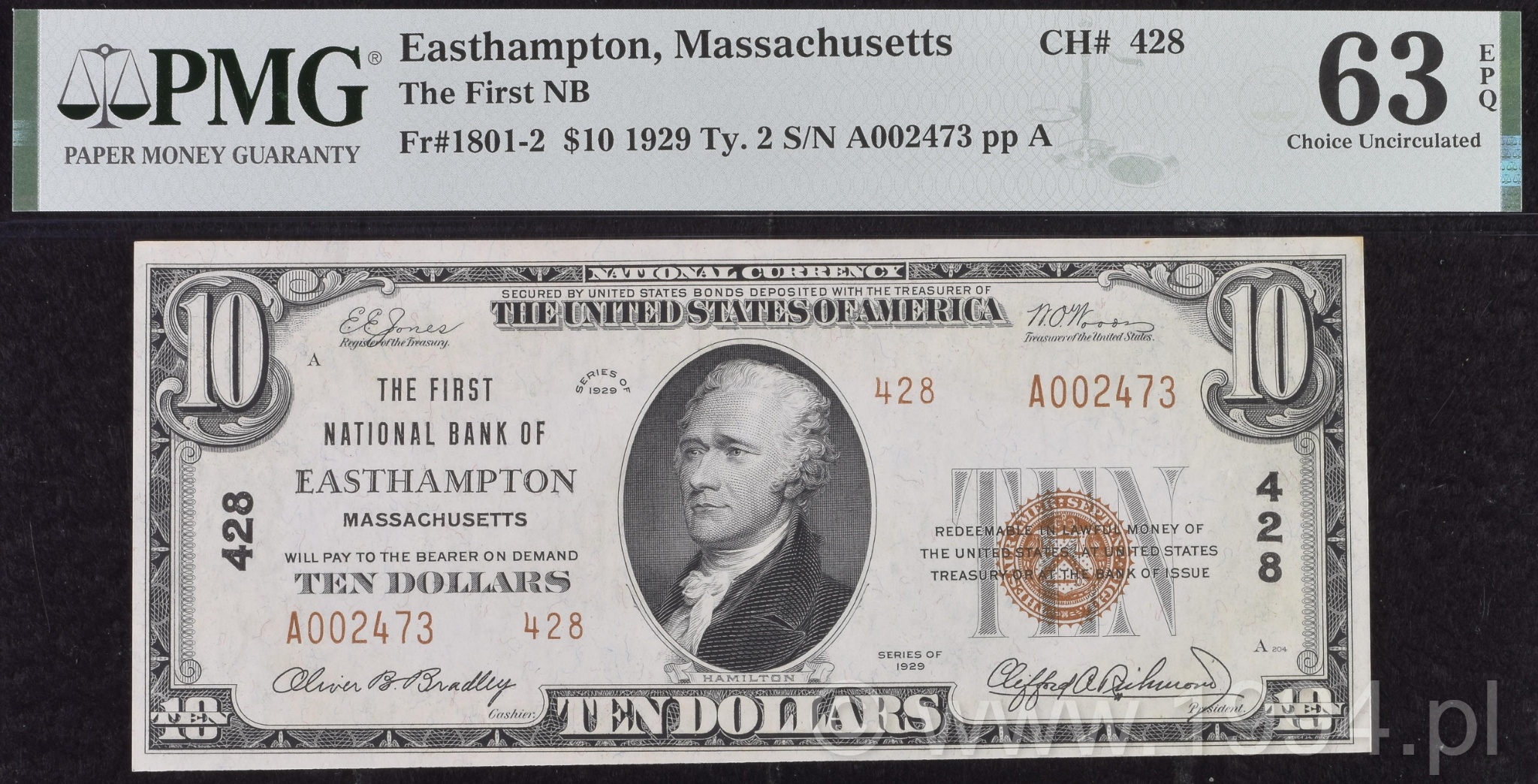
United States 1929 Type 2 - 10 Dollars National Bank Note The First National Bank of Easthampton Massachusetts Fr 1801-2 Chapter 428 PMG 63 EPQ

United States 1929 Type 2 - 10 Dollars National Bank Note - The First National Bank of Easthampton, Massachusetts Charter 428 (Fr. 1801-2)

Through seven decades of operation, the bank was led by a succession of presidents and cashiers who mirrored the town’s development from mill village to regional center: Williston and Horatio G. Knight in the 19th century, then Horace L. Clark and C. A. Richmond into the 1920s. Its resources peaked above 1.5 million dollars by 1929, a remarkable figure for a community of fewer than 10 000 people. The bank continued under its national charter until the mid-1930s, later transitioning into the federally insured system. Read more →

United StatesNational Bank Note192910 DollarsPMG 63 EPQ Choice Uncirculated 10 DollarsNational Bank NoteIssued NoteType 2EasthamptonMassachusettsCharter 428Hamilton1929PMG 63 EPQLocal Banking History
Held
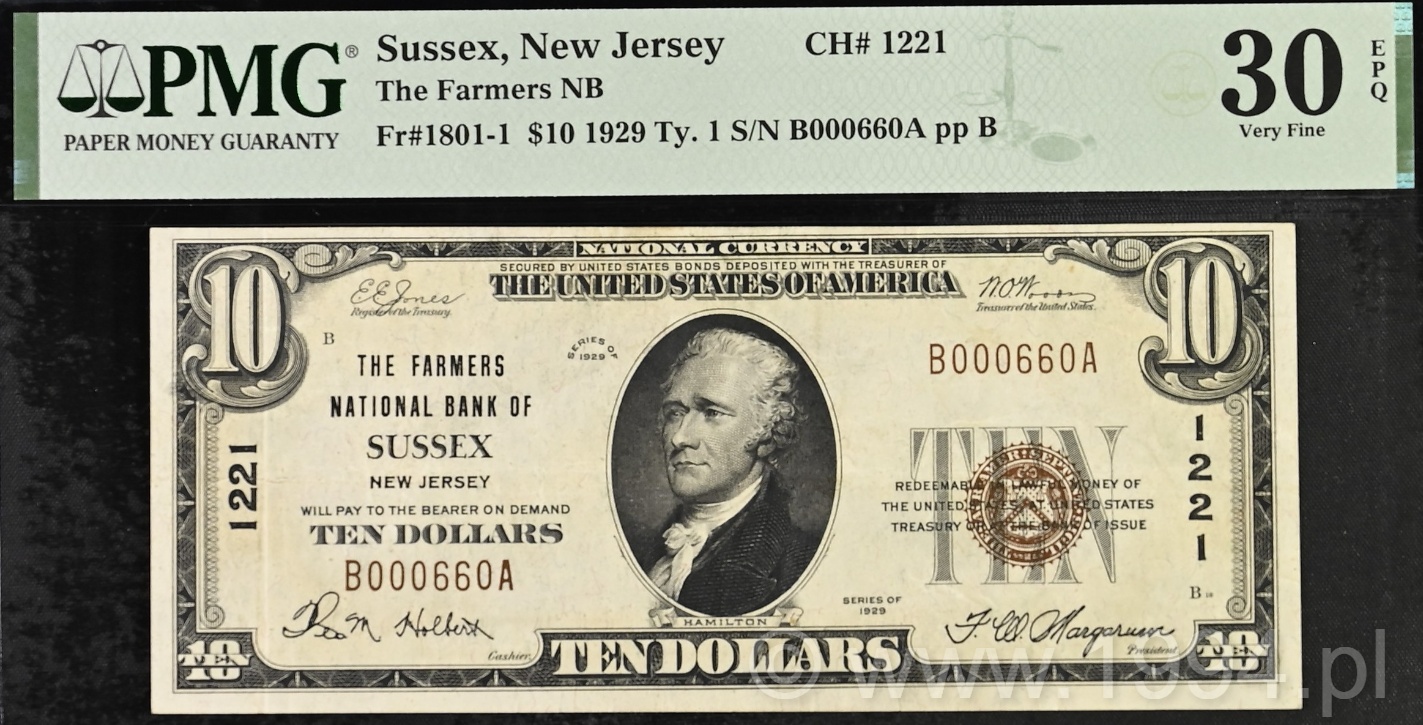
United States 1929 Type 1 - 10 Dollars National Bank Note The Farmers National Bank of Sussex New Jersey Fr 1801-1 CH 1221 PMG 30 EPQ

United States 1929 Type 1 - 10 Dollars National Bank Note - The Farmers National Bank of Sussex, New Jersey Charter 1221 (Fr. 1801-1)

Situated in a region defined by farming, iron mining, and dairy production, the bank’s lending underpinned the growth of rural northern New Jersey. Its resources expanded from 230 000 dollars in 1865 to more than 3 million by 1928-a scale remarkable for a farming town of fewer than 2 000 residents. Like thousands of similar community banks, it weathered recessions and banking panics through conservative management and local trust. Read more →

United StatesNational Bank Note192910 DollarsPMG 30 EPQ Very Fine 10 DollarsNational Bank NoteIssued NoteType 1SussexNew JerseyCharter 1221Hamilton1929PMG 30 EPQLocal Banking History
Held
United States 1995 10 Dollars Federal Reserve Note Minneapolis District Fr 2032-I Printed Tear Error PMG 66 EPQ Gem Uncirculated

United States 1995 – 10 Dollars Federal Reserve Note – Minneapolis District Printed Tear Error (Fr.2032-I)

Certified PMG 66 EPQ Gem Uncirculated, this example displays exceptional registration, full embossing, and perfect paper originality. It represents not only a striking visual oddity but also a case study in the intersection of industrial precision, human oversight, and collector fascination with the unintentional artistry of error notes. Read more →

United StatesError Note199510 DollarsPMG 66 EPQ Gem Uncirculated 10 DollarsFederal Reserve NoteIssued NoteError NotePrinted Tear ErrorMinneapolis1995HamiltonBureau of Engraving and PrintingPMG 66 EPQ
Held
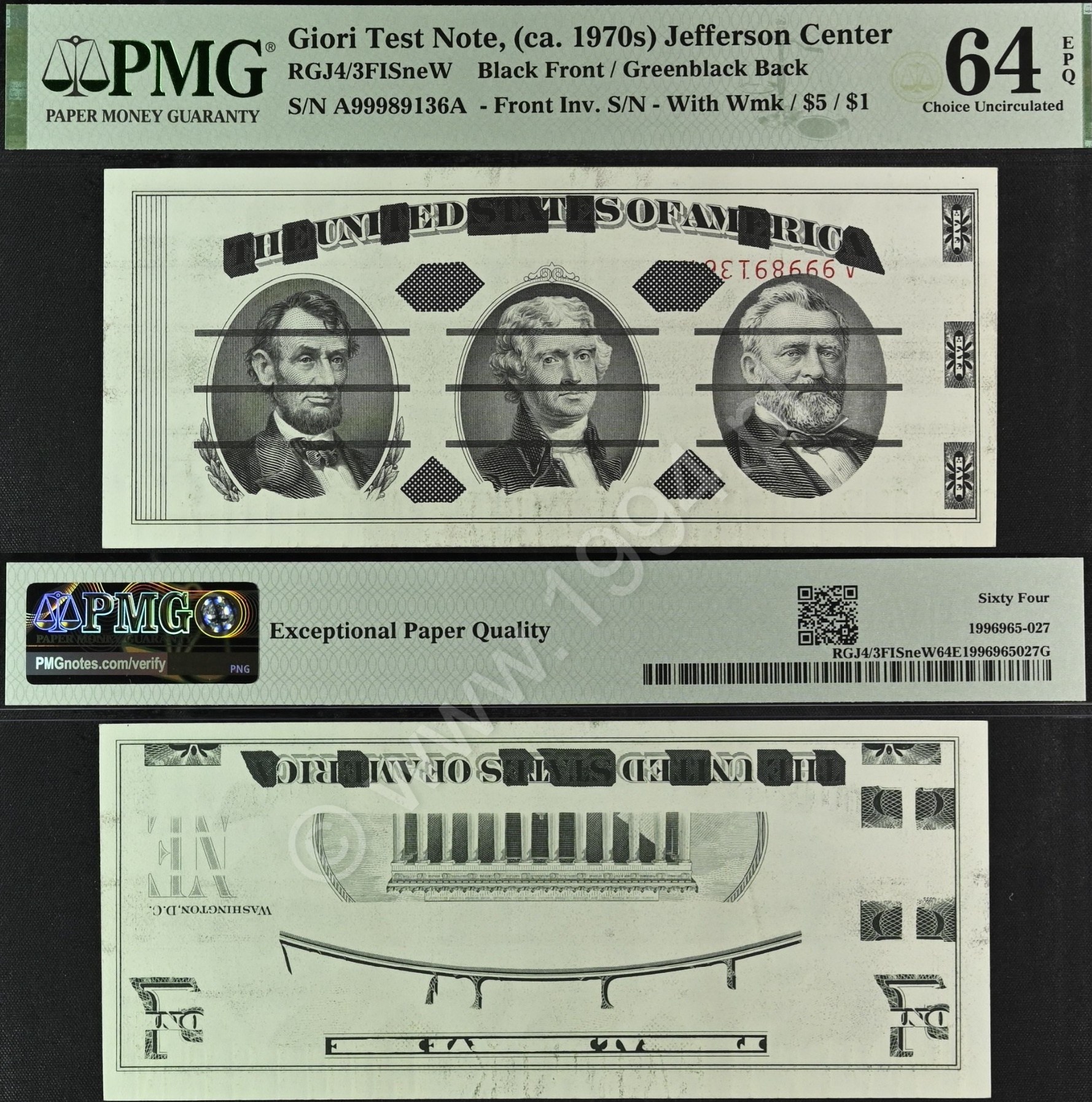
United States 1970s Giori Test Note Jefferson Center black front green back inverted red serial number CT68666 watermark PMG 64 EPQ Choice Uncirculated

United States ca. 1970s – Giori Test Note – Jefferson Center, Black Front / Greenback Inverted Experimental Serial With Watermark

Experimental intaglio test note printed around the 1970s by the Bureau of Engraving and Printing on the Giori multicolor press system. Named for engineer Giovanni Giori, these sheets were used to evaluate multi-plate registration, color density, and press alignment on machinery that would later define modern currency production. The design known as the Jefferson Center joins engraved portraits of Abraham Lincoln, Thomas Jefferson, and Ulysses S. Grant beneath a partial UNITED STATES OF AMERICA banner serving as a calibration reference. Read more →

United StatesTest Note1970Test NotePMG 64 EPQ Choice Uncirculated United StatesGiori Test NoteJefferson Center1970Black FrontGreenbackInverted SerialExperimental SerialWatermarkPMG 64 EPQ
Held
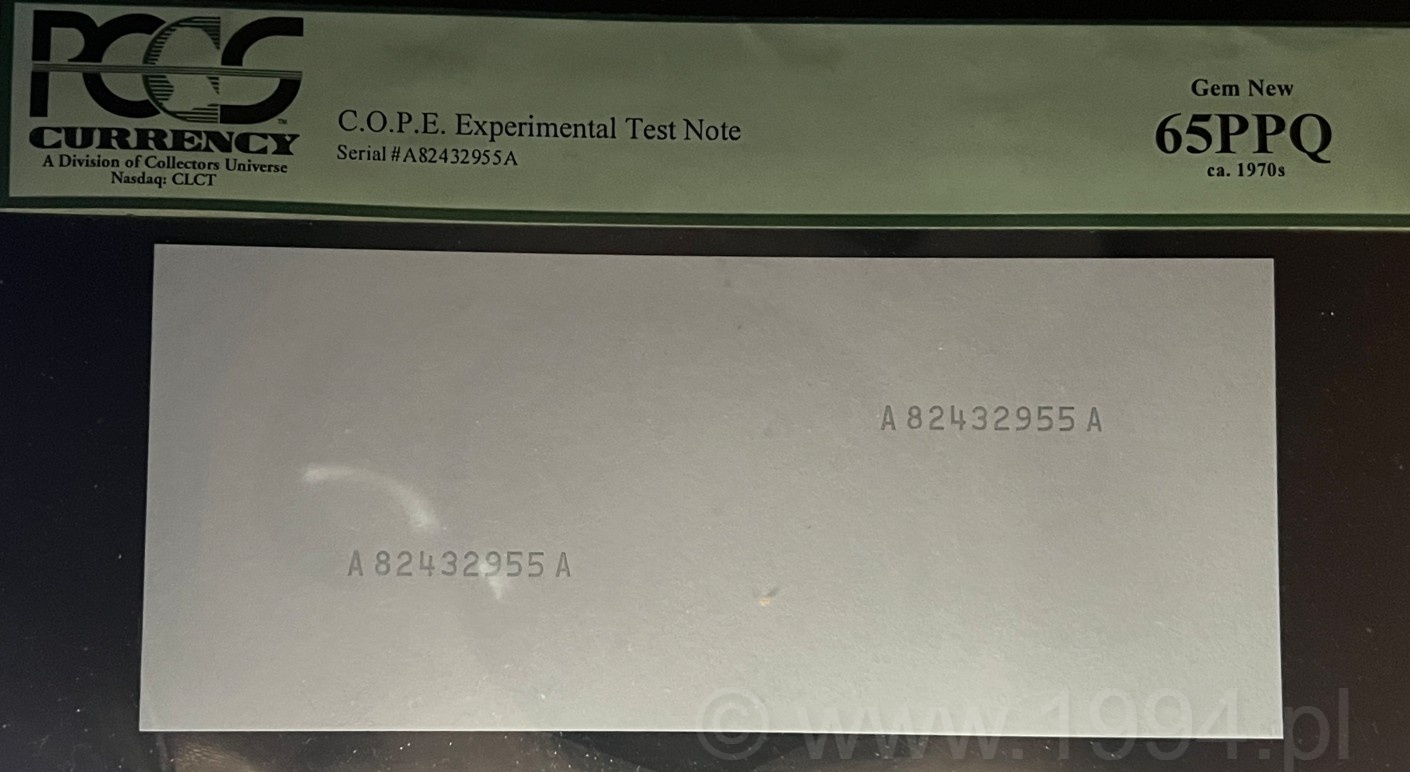
United States 1970s COPE Experimental Test Note serial A82432955A blank format PCGS 65 PPQ Gem New

United States ca. 1970s – C.O.P.E. Experimental Test Note Serial A82432955A

Few examples survived outside official archives, as almost all were destroyed after use. This specimen, preserved in pristine form, provides a direct glimpse into the mechanical evolution of U.S. paper currency manufacturing. Certified PCGS Currency Gem New 65 PPQ, it exhibits bright paper, razor-sharp serial impressions, and full margins-an exceptionally rare survivor from the development phase of America’s first automated currency-processing era. Read more →

United StatesTest Note1970Test NotePCGS 65 PPQ Gem New United StatesCOPE Test NoteExperimental1970Serial Number CalibrationBureau of Engraving and PrintingPCGS 65 PPQCurrency Overprinting and Processing Equipment
Held
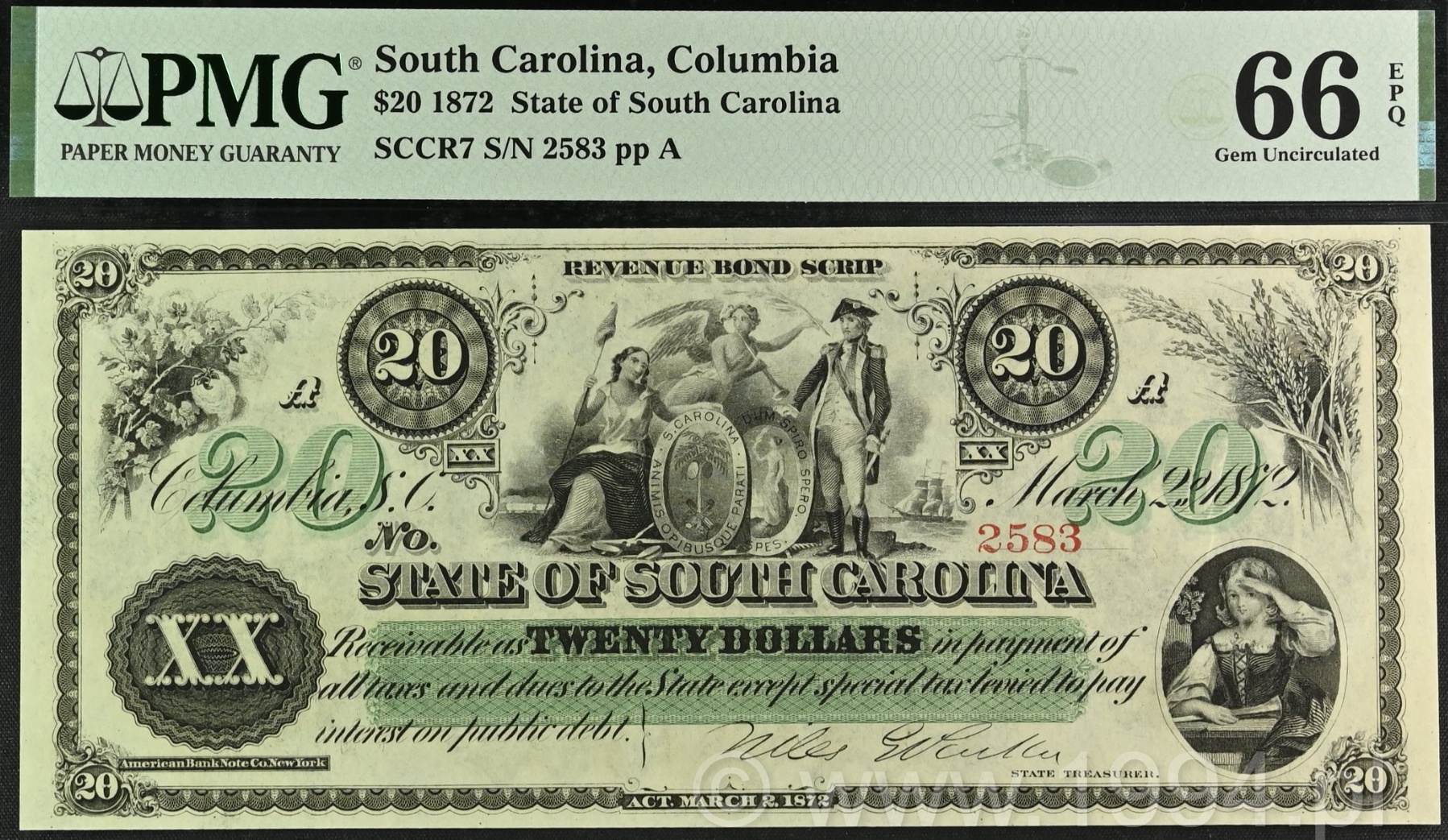
United States 1872 State of South Carolina 20 Dollars Revenue Bond Scrip Columbia Act March 2 1872 PMG 66 EPQ Gem Uncirculated

United States 1872 – State of South Carolina $20 Revenue Bond Scrip Act of March 2 1872 Columbia Issue

Certified PMG 66 EPQ Gem Uncirculated, this example is a superb survivor with original color, sharp embossing, and flawless margins. Its preservation underscores the artistry and historical resonance of state-issued scrip-a tangible relic of South Carolina’s attempt to restore credit, taxation, and public trust in the uncertain years following Reconstruction. Read more →

United StatesState Issue187220 DollarsPMG 66 EPQ Gem Uncirculated United StatesSouth CarolinaColumbiaState IssueRevenue Bond Scrip1872ABNCAmerican Bank Note CompanyReconstruction EraPMG 66 EPQGem Uncirculated20 Dollars
Held
↑ Top