Collection PL

About
493 results · Page 2 of 42
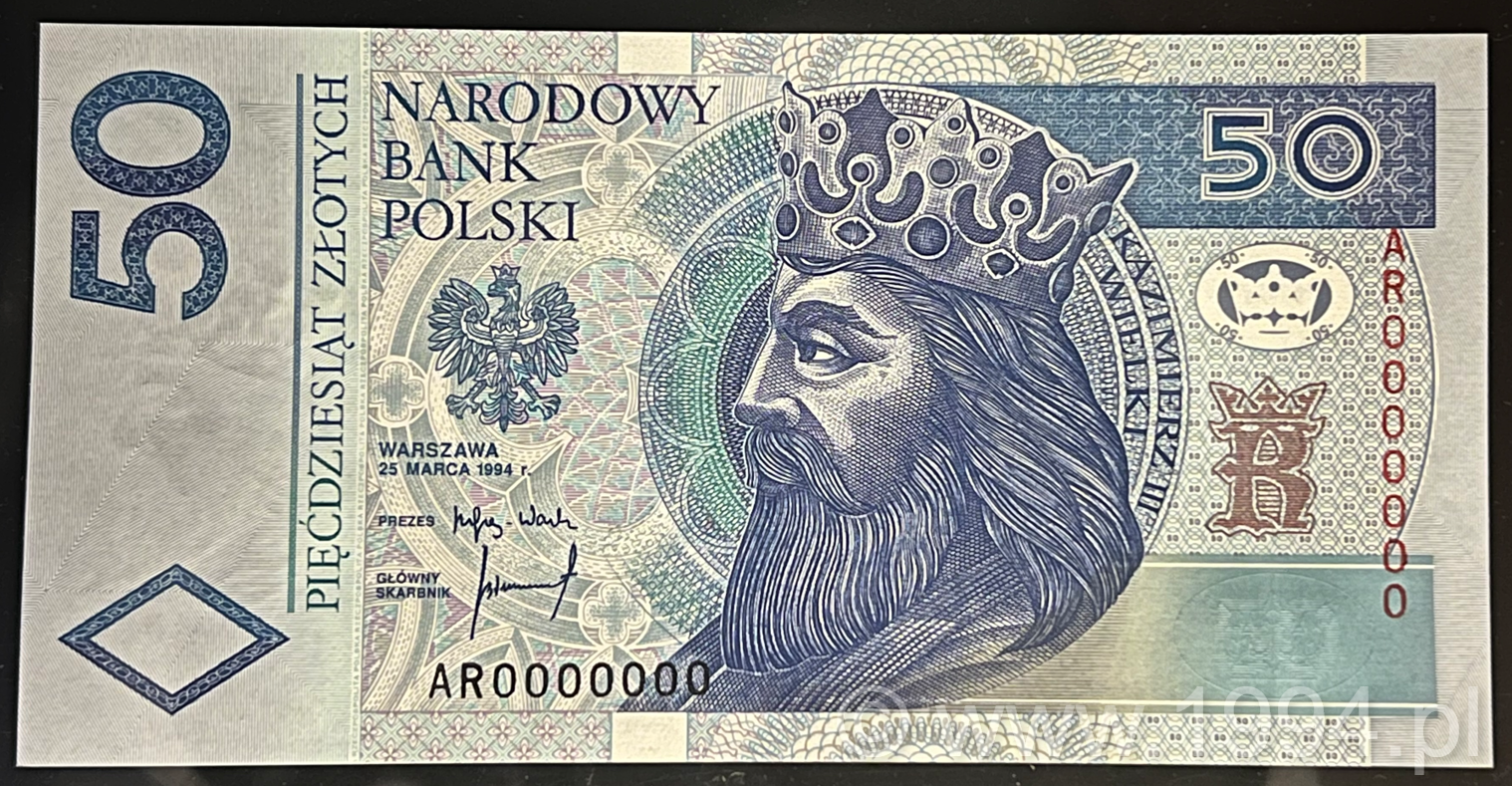
Poland 1994 50 Zlotych AR prefix approval specimen without overprints, serial AR0000000, produced by Thomas De La Rue

Poland 1994 - 50 Zlotych Approval Specimen Without Overprints AR Prefix (Pick Unlisted)

This example documents the use of a previously unrecorded AR prefix on a known approval specimen type of the 50 zlotych banknote from the 1994 Polish issue. The note is a fully printed approval specimen produced by Thomas De La Rue in London for the National Bank of Poland as part of the formal approval process for the final design intended for circulation. It retains the complete structure of the emission design, corresponding to the version that subsequently entered regular production. ... Read more →

PolandApproval Specimen Without Overprints199450 ZlotychUncirculated Approval SpecimenApproval Specimen Without OverprintsSpecimenUncataloguedAR PrefixSerial AR0000000Thomas De La RueTDLRMilczak UnlistedPick UnlistedPoland Currency Redesign 1994National Bank of PolandModern Polish BanknotesSecurity Printing HistoryDesign Approval ProcessPre Issue Control NotePoland199450 ZlotychMuseum GradeR9 Extremely RareUnique
Held
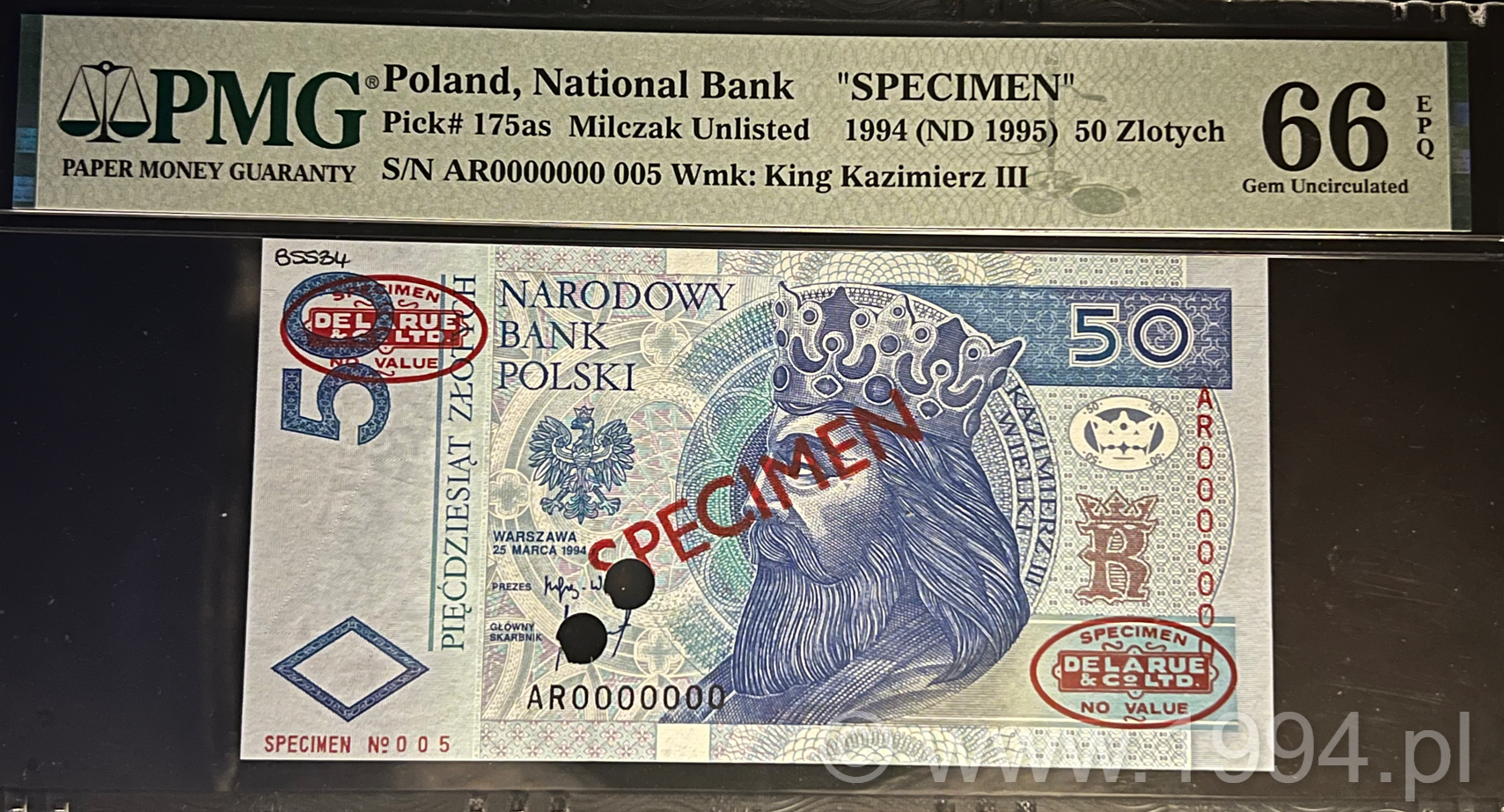
Poland 1994 50 Zlotych AR Specimen with red SPECIMEN overprint, De La Rue NO VALUE ovals, and drilled control holes

Poland 1994 - 50 Zlotych Specimen with Red Overprint & Oval Stamp AR Prefix (Pick Unlisted)

This AR-prefix specimen is a fully printed presentation example of the 50 zlotych banknote from Poland’s 1994 series, prepared by Thomas De La Rue for controlled institutional use. The note preserves the complete production design corresponding to the issued banknote and carries serial number AR0000000 together with the official signatures of the National Bank of Poland. A bold red diagonal SPECIMEN overprint spans the face of the note and is accompanied by two red oval NO VALUE stamps applied in the standard De La Rue format. ... Read more →

PolandSpecimen with Red Overprint & Oval Stamp199450 ZlotychPMG 66 EPQ Gem Uncirculated SpecimenApproval SpecimenRed OverprintOval NO VALUE StampPunch CancelledSpecimen Tracking PanelAR PrefixSerial AR0000000Pick UnlistedMilczak UnlistedUncataloguedThomas De La RueTDLRSecurity Printing HistorySpecimen Control ProceduresModern Banknote DevelopmentPoland199450 ZlotychPMG 66 EPQMuseum GradeR9 Extremely RareUnique
Held
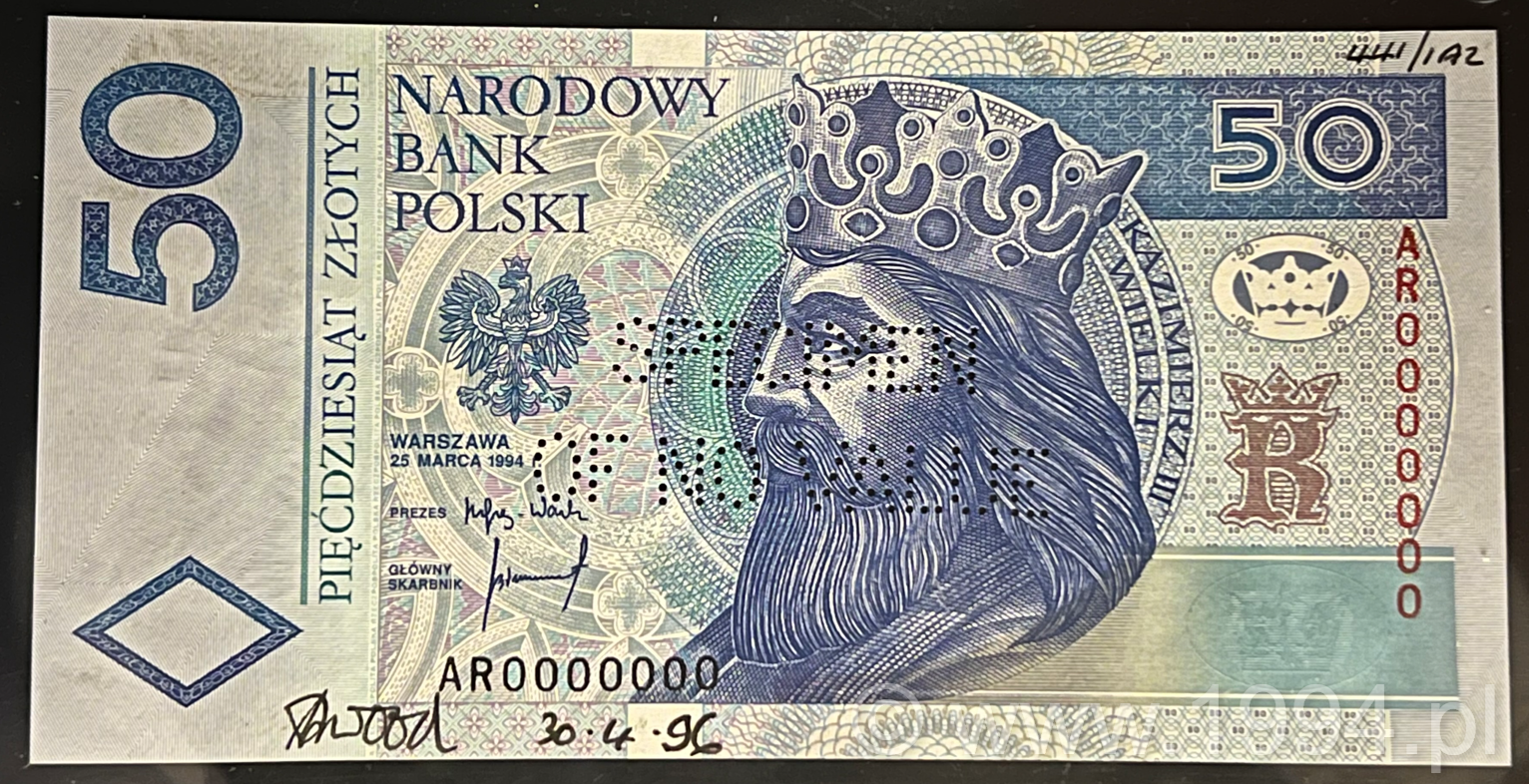
Poland 1994 50 Zlotych AR Specimen perforated SPECIMEN OF NO VALUE with handwritten archive date 30.4.96

Poland 1994 - 50 Zlotych Specimen with Perforated 'SPECIMEN OF NO VALUE' AR Prefix (Pick Unlisted)

This AR-prefix specimen is a fully printed 50 zlotych banknote from Poland’s 1994 series, permanently cancelled by a large perforated inscription reading “SPECIMEN OF NO VALUE” across the portrait of King Casimir III the Great. The perforation represents a terminal archival control form prepared by Thomas De La Rue and retained for internal documentation and security reference. The banknote preserves the complete production design corresponding to the issued currency, including serial number AR0000000 and the official signatures of the National Bank of Poland. ... Read more →

PolandSpecimen Perforated 'SPECIMEN OF NO VALUE'199450 ZlotychUncirculated SpecimenApproval SpecimenPerforatedPerforated 'SPECIMEN OF NO VALUE'Printer AnnotationsUncataloguedAR PrefixSerial AR0000000Thomas De La RueTDLRMilczak UnlistedPick UnlistedThree Known Variations of 1994 Polish SpecimensPoland Currency Redesign 1994National Bank of PolandModern Polish BanknotesSecurity Printing HistoryDe La Rue Archival ControlSpecimen Control ProceduresPoland199450 ZlotychMuseum GradeR9 Extremely RareUnique
Held
Complete nine-note Stockholm Spinnhus pollett monetary system from circa 1785, including all denominations from one half öre to one daler, preserved in unissued condition and classified as R10 extremely rare.

Sweden 1785 - Stockholm Spinnhus Pollett System – Complete Nine-Denomination Institutional Currency Set (One Half Öre to One Daler)

This complete nine-note ensemble represents the entire internal monetary system of Stockholm’s Spinnhus, the women’s correctional institution and workhouse operating on Långholmen Island during the late eighteenth century. Produced circa 1785, these engraved pollett notes functioned as closed-economy institutional currency, issued exclusively for use within the prison environment. They served as a controlled medium of exchange through which inmates were compensated for labor, particularly the spinning and processing of flax and wool. ... Read more →

SwedenInstitutional Paper Currency Set1785Complete nine-note system: one half öre, one öre, two öre, five öre, six öre, seven öre, sixteen öre, twenty-four öre, one dalerUncirculated PollettInstitutional paper currencyEngraved copperplate noteEighteenth century rag paperAnopisthographic printingUnissuedUncirculatedStockholm engravingSwedish copperplate productionPre-industrial note manufactureStockholm SpinnhusLångholmen prison economyPenal labor currencyClosed economy tenderProto-fiat institutional moneyInternal monetary systemSweden1785One half öreOne öreTwo öreFive öreSix öreSeven öreSixteen öreTwenty-four öreOne dalerFull denomination setPick UnlistedR10 UniqueR10UniqueUnique Known ExampleUnique Set
Unissued
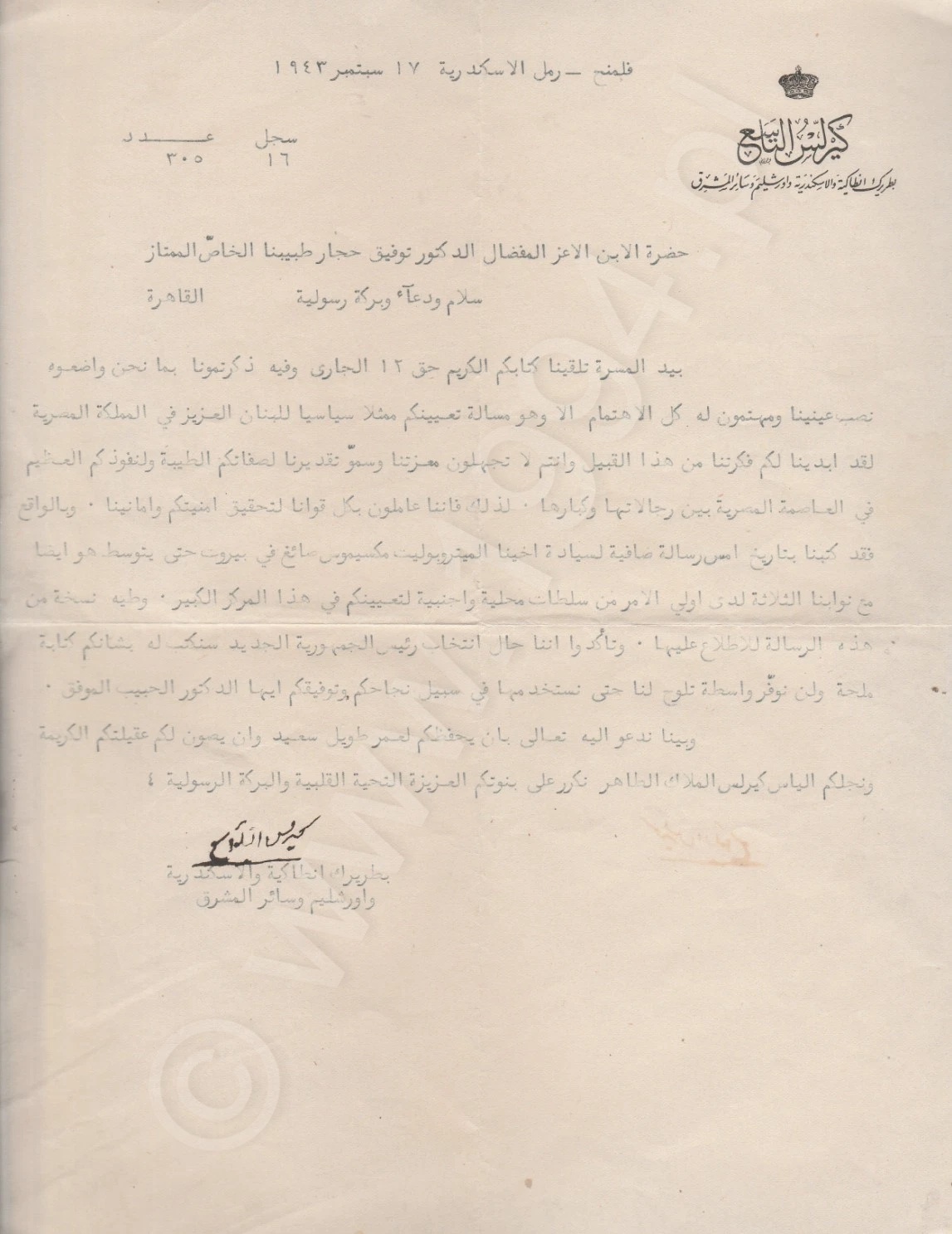
1943 Patriarchal letter signed by Cyril IX Moghabghab, Melkite Greek Catholic Patriarch, issued in Alexandria

Egypt 1943 - Cyril IX Moghabghab, Melkite Greek Catholic Patriarch (Signed Patriarchal Letter, Alexandria)

Official Patriarchal letter dated 17 September 1943 and issued from the Melkite Greek Catholic Patriarchate residence in Fleming–Ramleh, Alexandria. Typed on cream chancery paper with faint laid lines and bearing the crowned Patriarchal emblem at upper right, the document is internally registered as 'عدد 305' and 'سجل 16,' confirming it as an authenticated in-period chancery file copy. Addressed to Dr. ... Read more →

EgyptEcclesiastical Document1943N/A (Patriarchal Correspondence)Uncertified (VF, Strong Signature, Full Text Intact) Ecclesiastical DocumentPolitical CorrespondenceMelkite Greek Catholic ChurchPatriarch of Antioch Alexandria JerusalemCyril IX MoghabghabSigned LetterPatriarchal ChanceryReligious LeadershipChristian EgyptLevantine ChristianityMiddle Eastern ChristianityLebanese RepresentationChurch and StateWWII EgyptClerical InfluenceEgyptAlexandria1943Museum GradeR9 Extremely RareUnique
Held
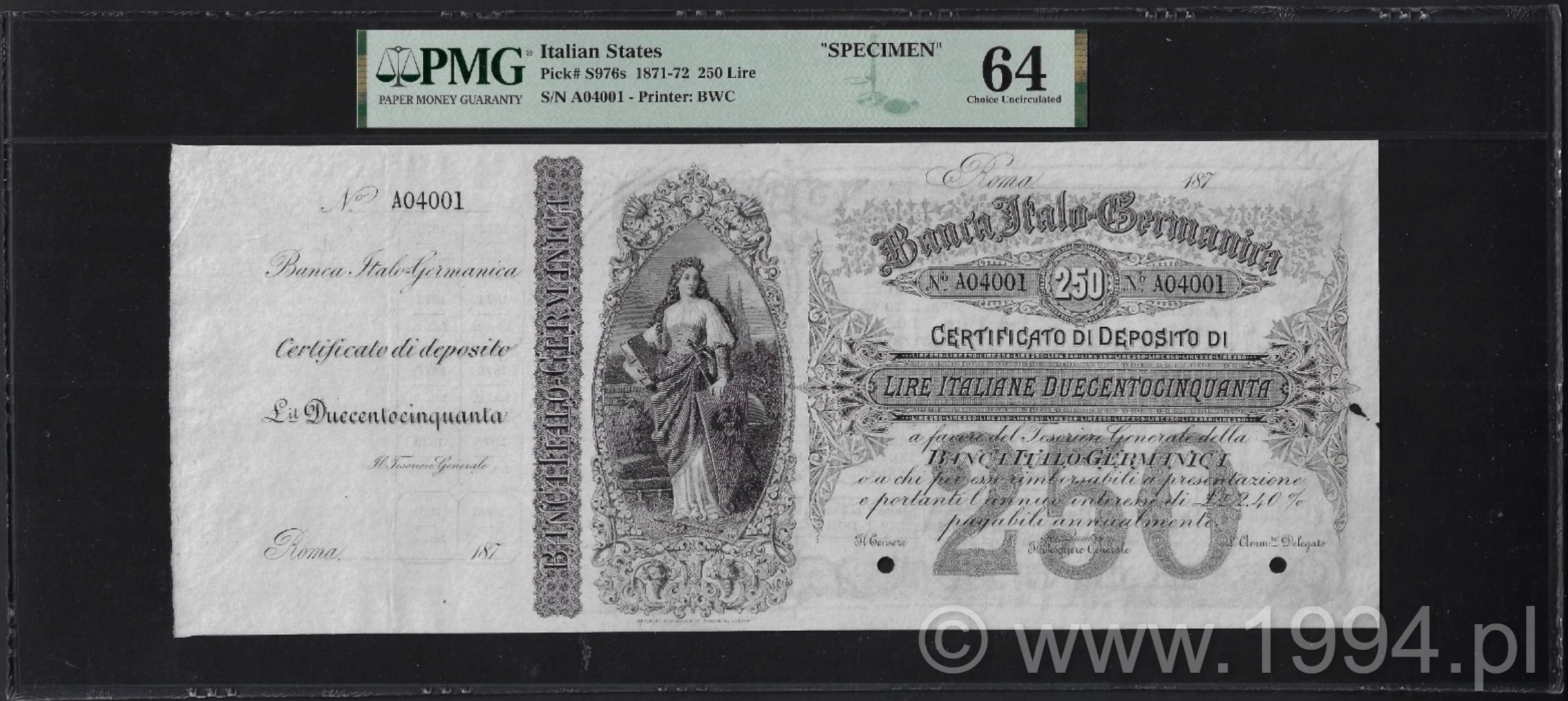
Italy 1871–1872 Banca Italo-Germanica 250 Lire specimen, Pick S976s, Bradbury Wilkinson & Co., PMG 64 Top Pop

Italy 1871–1872 - Banca Italo-Germanica 250 Lire Specimen (Pick S976s)

An exceptional and academically important survival from the experimental phase of Italy’s early post-unification banking era, this 250 Lire specimen from the short-lived Banca Italo-Germanica, cataloged as Pick S976s, represents one of the rarest and most ambitious private note-issuing projects attempted in Rome during the 1870s. No issued examples of this type are known to exist, and all scholarship indicates that the bank’s banknote program collapsed before any notes entered circulation, leaving only a microscopic number of presentation pulls, proofs, or internal printer’s archive sheets. This PMG 64 Choice Uncirculated example is the sole graded specimen in the PMG census, making it both Top Pop and Only Pop. ... Read more →

ItalySpecimen1871250 LirePMG 64 (Top Pop) Private BankOversizedSpecimenDouble Punch HolePunch Cancelled250 LireEngraved Security PaperProof and Archive PieceBradbury WilkinsonBWCPick S976sItalian StatesPost Unification ItalyItalian Banking HistoryFailed Banknote IssuesGerman Capital in Italy19th Century FinanceNational AllegorySecurity Printing HistoryRome Banking ExperimentsUnissued Banknote ProjectItaly1871PMG 64Top PopR9 Extremely RareUniqueMuseum Grade
Held
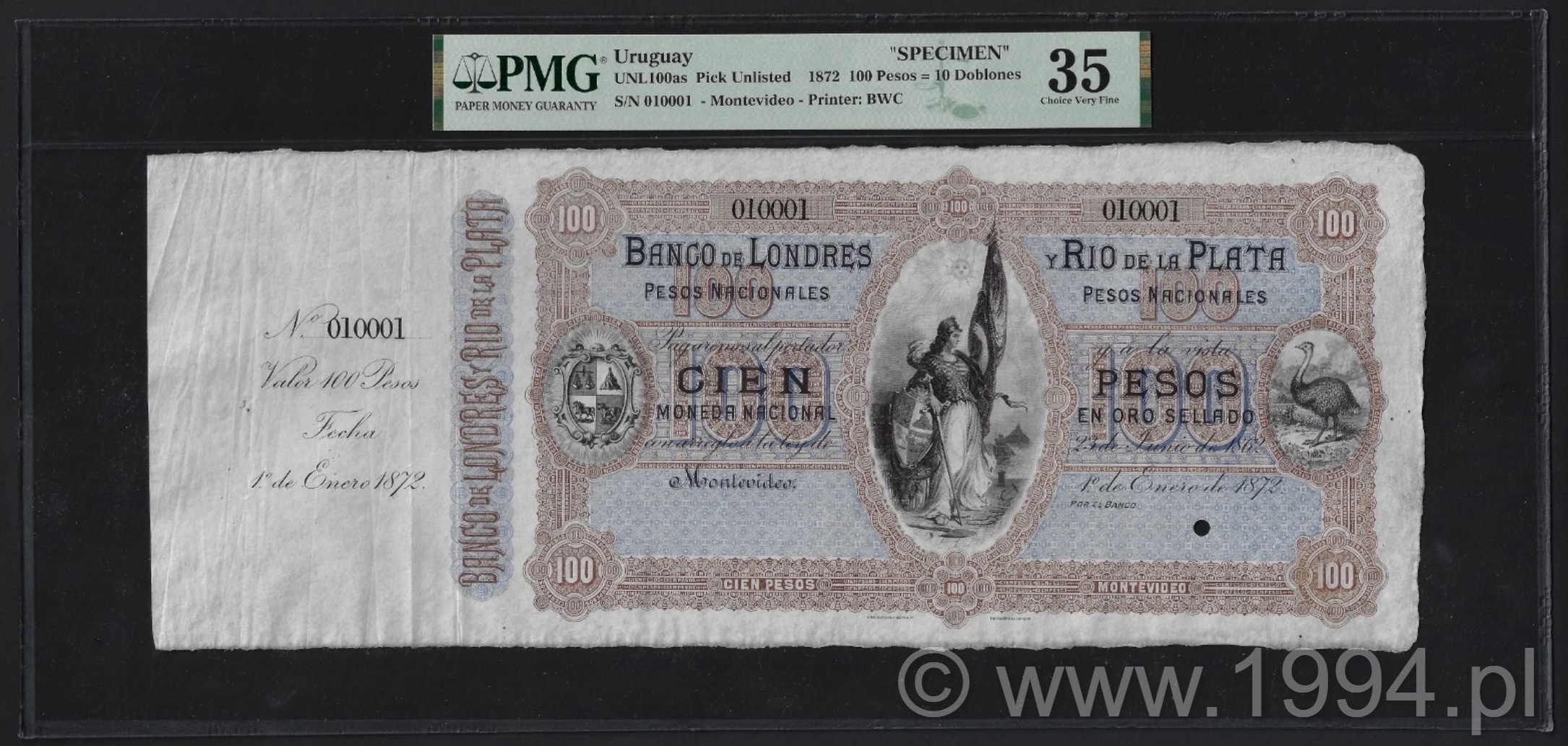
Uruguay 1872 100 Pesos equals 10 Doblones printer archival specimen, early serial number 010001, printed by Bradbury Wilkinson

Uruguay 1872 - 100 Pesos = 10 Doblones Specimen (Pick Unlisted)

A printer’s archival specimen of the 1872 issue of the Banco de Londres y Rio de la Plata, denominated 100 Pesos Nacionales with an explicit equivalence to 10 Doblones in gold. This dual-denomination construction represents one of the most ambitious monetary experiments undertaken in nineteenth-century Uruguay, attempting to anchor paper currency directly to a fixed gold value at a time of persistent instability and public distrust in fiduciary issues. The note was produced in London by Bradbury, Wilkinson & Co. ... Read more →

UruguaySpecimen1872100 Pesos = 10 DoblonesPMG 35 Choice Very Fine SpecimenPrinter Archival SpecimenDual DenominationGold EquivalenceEarly Pull Serial 010001Oversized FormatBradbury WilkinsonBWCLondon Security PrintingNineteenth Century EngravingArchival Reference NoteGold Standard ExperimentPeso Doblone ParityBanco de Londres y Rio de la PlataLatin American Monetary HistoryNineteenth Century State FinanceUruguayMontevideo1872Pick UnlistedMuseum GradeR9 Extremely RareUnique
Held
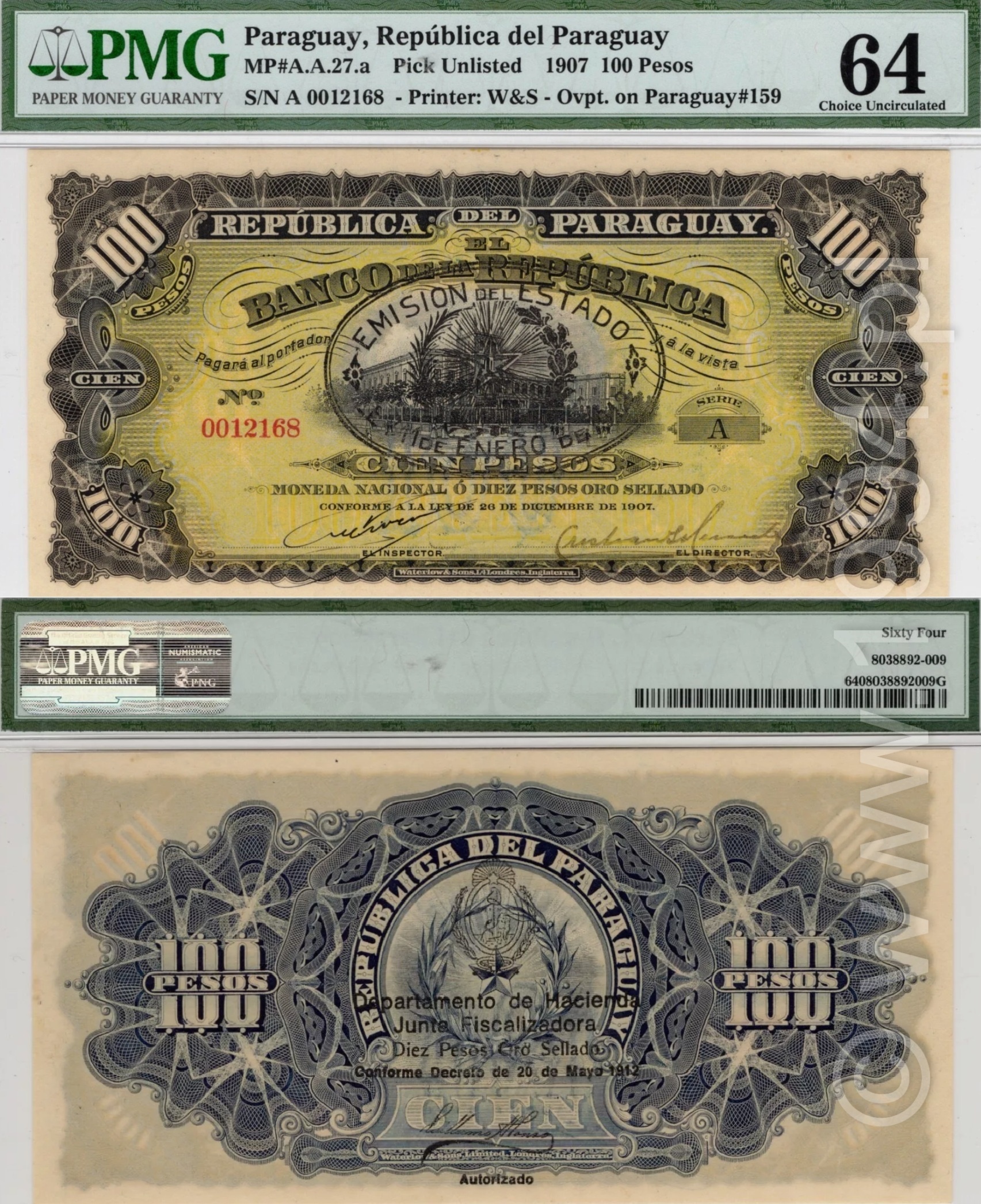
Paraguay 1907 100 Pesos Banco de la República specimen with 1912 dual-side state and treasury fiscal revalidation overprint, including Emisión del Estado on the face and Departamento de Hacienda Junta Fiscalizadora Diez Pesos Oro Sellado validation on the reverse, base Pick 159, Pick Unlisted, PMG 64 Choice Uncirculated

Paraguay 1907 - 100 Pesos with 1912 Dual-Side State and Treasury Revalidation Overprint Specimen (Pick Unlisted)

Archival specimen of the 1907 Banco de la República 100 Pesos, base Pick 159, printed by Waterlow & Sons, London, and later transformed by one of the most historically revealing emergency overprint configurations in Paraguayan paper money. The note bears the large face overprint “Emisión del Estado – 11 de Enero de 1912,” together with the reverse fiscal validation “Departamento de Hacienda – Junta Fiscalizadora – Diez Pesos Oro Sellado – Conforme Decreto de 20 de Mayo 1912.” This dual-side treatment places the note outside the ordinary single-face revalidation pattern and identifies it as a treasury-controlled specimen of exceptional documentary importance. The significance of the reverse overprint is especially important. ... Read more →

ParaguayOverprint Specimen1907100 PesosPMG 64 Choice Uncirculated Specimen100 PesosPick UnlistedPick 159OverprintState OverprintTreasury OverprintDual-Side OverprintDual-Signature OverprintProvisionalFiscal RevalidationTreasury RevalidationEmergency State IssueParaguayan Emergency Issues1912 ReformJanuary 11 1912 State EmissionMay 20 1912 DecreeBanco de la RepúblicaDepartamento de HaciendaJunta FiscalizadoraEmisión del EstadoDiez Pesos Oro SelladoGold-Value ReaffirmationWaterlow & SonsSouth American Monetary HistoryEarly 20th Century FinanceGovernment RevalidationOverprint VarietiesParaguay19071912PMG 64Choice UncirculatedMuseum GradeR9 Extremely RareUnique
Held
Late Qing Sinkiang textile emergency currency printed on red-dyed cloth using hand-carved woodblocks, circa 1880

China 1880 - Sinkiang Textile Emergency Currency, Cloth Note (Pick Unlisted)

This textile emergency currency from Sinkiang belongs to the late Qing frontier monetary tradition, when regional authorities relied on locally produced substitutes in response to chronic shortages of official coin and paper money. Executed on coarse red-dyed cloth and printed by hand-carved woodblocks, the note reflects a monetary environment shaped by isolation, logistical constraints, and reliance on pre-modern administrative practices. The use of textile as a monetary substrate is not symbolic but functional. ... Read more →

ChinaTextile Emergency Currency1880Unknown Local DenominationFine (Textile Issue) Textile BanknoteTextile Emergency CurrencyCloth BanknoteCloth NoteHand-Carved Woodblock PrintingLate Qing Frontier IssueWoodblock PrintingSinkiangChina1880R9 Extremely RareUniqueMuseum GradePick Unlisted
Held
China 1915 South Sinkiang Border Defence Headquarters 1 tael textile emergency banknote printed on woven cloth with red overprint and bilingual inscriptions

China 1915 - South Sinkiang Border Defence Headquarters 1 Tael Textile Emergency Issue (Pick Unlisted)

This 1 tael textile banknote represents a formally authorized military emergency issue produced in 1915 by the South Sinkiang Border Defence Headquarters during a period of severe administrative and monetary fragmentation in western China. Issued within the southern frontier zone encompassing Khotan, Yarkand, and Karghalik, the note reflects a localized system of fiscal control exercised by military authorities operating with substantial autonomy from central government structures. The banknote is printed on hand-woven textile rather than paper, a deliberate and practical choice dictated by frontier conditions. ... Read more →

ChinaTextile Banknote19151 TaelFine (Textile Issue) Textile BanknoteTextile Emergency CurrencyCloth CurrencyMilitary Emergency Issue1 TaelWoodblock PrintingRed OverprintSouth Sinkiang Border Defence HeadquartersFrontier Military AdministrationRegional Monetary SystemUyghur-Chinese Bilingual IssueCentral Asian Frontier FinanceSecurity Printing HistoryChinaSinkiangSouth Sinkiang1915R9 Extremely RareUniqueMuseum GradePick Unlisted
Held
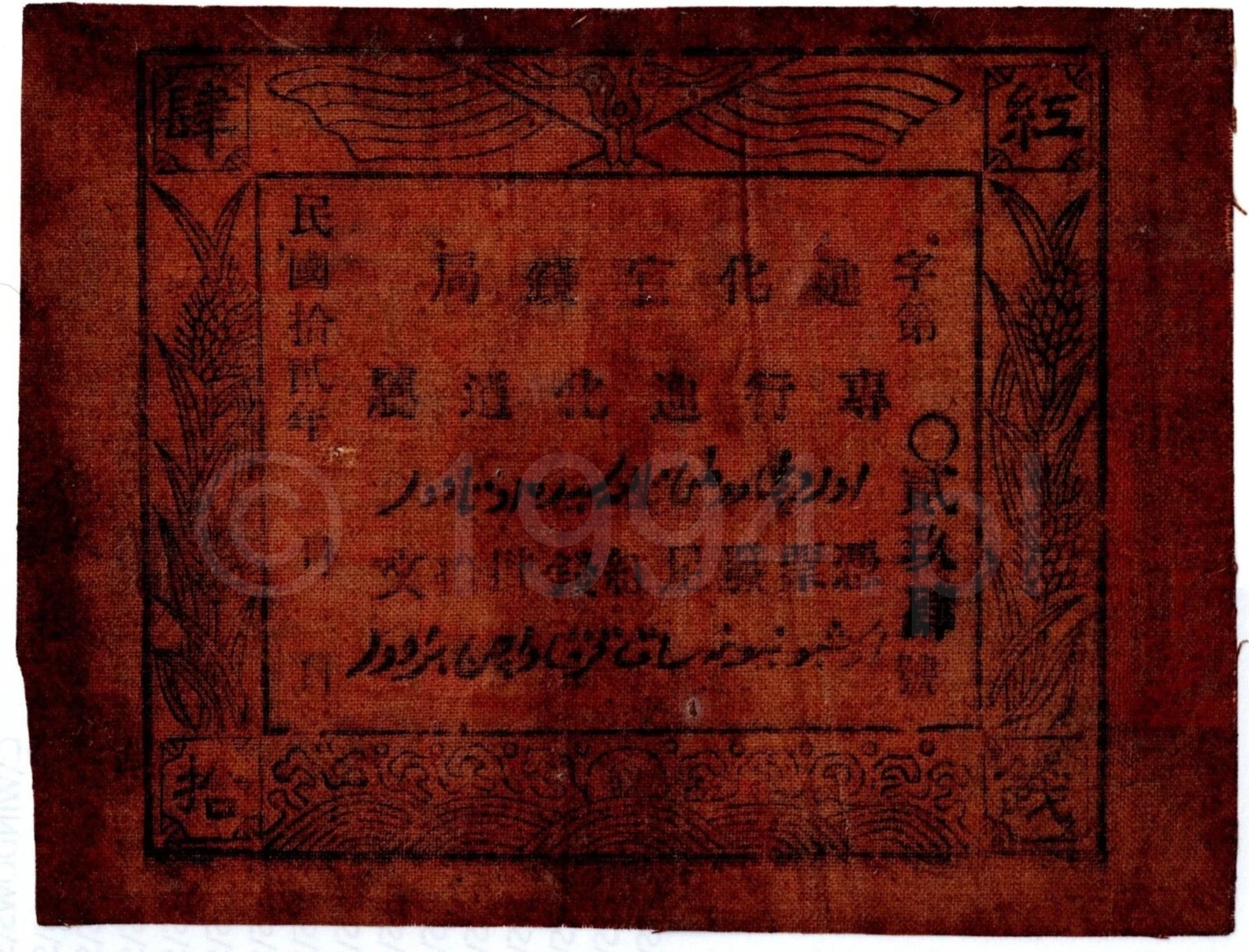
China 1918 Xinjiang textile emergency currency printed on red cloth by woodblock, with framed inscription panel, vegetal side borders, winged emblem, and wave-pattern lower band

China 1918 - Xinjiang Textile Emergency Currency Printed on Red Cloth, Local Authority Issue (Pick Unlisted)

An issued textile emergency currency produced in Xinjiang (Sinkiang) during the early Republican period, printed by hand from carved woodblocks onto red-dyed cotton cloth. This note represents a locally authorized substitute currency created for circulation under conditions of monetary instability, material shortage, and fragmented administrative control in China’s western frontier. The design is printed directly onto fabric in dark ink, with the textile weave clearly visible through the impression. ... Read more →

ChinaTextile Emergency Currency1918UnspecifiedIssued (Textile Emergency Currency) Textile BanknoteTextile Emergency CurrencyCloth BanknoteIssued Emergency MoneyWoodblock PrintingFrontier CurrencyXinjiangSinkiangLocal Authority IssueEarly Republican PeriodRegional Monetary SystemChina1918Museum GradeR9 Extremely RareUniquePick Unlisted
Held
China 1920 Xinjiang textile emergency currency printed on red cloth by woodblock, showing framed inscription panel and ornamental borders

China 1920 - Xinjiang Textile Emergency Currency Printed on Red Cloth, Local Authority Issue (Pick Unlisted)

An issued textile emergency currency produced in Xinjiang (Sinkiang) in the early Republican period, printed by hand from woodblock onto coarse red-dyed cotton cloth. This note forms part of the broader tradition of frontier textile currency developed in western China under conditions of monetary instability, material shortage, and decentralized administrative control. The design is executed in dark ink directly on fabric, with the weave of the cloth clearly visible through the printed impression. ... Read more →

ChinaTextile Emergency Currency1920UnspecifiedIssued (Textile Emergency Currency) Textile BanknoteTextile Emergency CurrencyCloth BanknoteIssued Emergency MoneyWoodblock PrintingFrontier CurrencyXinjiangSinkiangLocal Authority IssueEarly Republican PeriodRegional Monetary SystemChina1920Museum GradeR9 Extremely RareUniquePick Unlisted
Held
↑ Top