Collection PL

About

New Zealand’s paper money developed under a private-bank system long before monetary centralization. Through the late nineteenth and early twentieth centuries, trading banks operating under statute—most prominently the Bank of New Zealand—placed London-engraved notes into circulation, redeemable on demand and trusted across a geographically dispersed, export-driven economy. Design and production standards were aligned with British practice, ensuring that New Zealand notes would be accepted both domestically and within imperial settlement networks.

The private-bank sequence represented here was engraved and printed by Bradbury, Wilkinson & Co., London, whose disciplined approach to denomination hierarchy, color coding, and serial logic defined the visual and functional grammar of Bank of New Zealand issues. The lineage progresses from the early £1 Green through the £5 Orange and £10 Brown, culminating in the seldom-seen £20 Blue—the highest practical denomination issued by New Zealand’s private banks prior to 1934.

The £20 Blue audit-range specimen (Pick S194s) represents the apex of this system. Executed in subdued blue-slate tones reserved for the highest settlement tier, it carries dual live serials rather than a zero-serial format, identifying it as an internal audit and approval piece retained by Bradbury Wilkinson during plate alignment, tint calibration, and numbering verification. Such audit-range specimens were never intended for public or institutional circulation and were almost universally destroyed once approval was complete.

Wartime production introduces a second layer of complexity. The £5 Red-Rose specimen (Pick S227s), printed during the 1916–1920 period, reflects material constraints and pigment shifts imposed by the First World War while preserving its position within the established BNZ color hierarchy. This specimen retains dual live serial prefixes and carries contemporary printer annotations, confirming its role as an internal audit and control document rather than a display specimen. Its survival provides rare evidence of how Bradbury Wilkinson managed quality control under wartime conditions.

Together, these specimens document more than denomination progression. They preserve the internal mechanics of private-bank note production: audit-range serial blocks, multi-serial approval formats, pencilled press annotations, and cancellation strategies designed to prevent accidental circulation. These features are not peripheral details—they are the operational language of the system.

Monetary centralization arrived with the establishment of the Reserve Bank of New Zealand in 1934, ending private note issue and introducing a unified national currency. The Bank of New Zealand specimens shown here therefore represent the final, fully matured phase of New Zealand’s private-bank era. Read together, they trace a complete arc: from early commercial trust-building, through wartime adaptation, to the threshold of central banking.

51 results · Page 1 of 5
New Zealand 1907–1926 Bank of New Zealand £20 Blue audit-range serial-prefix specimen with dual control numbers, Bradbury Wilkinson & Co., PMG 55 AU, Pop 1/1, R9 Extremely Rare

New Zealand 1907–1926 — Bank of New Zealand £20 Blue Serial-Prefix Audit Specimen (Pick S194s)

A unique high-denomination Bradbury Wilkinson audit-range specimen and the rarest surviving document from New Zealand’s private-banknote era, the £20 Blue (Pick S194s) represents the apex of BNZ’s color-coded denomination hierarchy. This specimen is not a generic zero-serial example: it carries dual live serials (No. 061001 and No. ... Read more →

New ZealandSpecimen190720 PoundsPMG 55 About Uncirculated (Pop 1/1) Specimen20 PoundsBlueBNZ Color LineageHigh Denomination Color TierHigh DenominationAudit-Range SpecimenSerial PrefixDual Serial NumbersPerforated SpecimenBradbury WilkinsonBWCPick S194sBank of New ZealandPrivate Banknote EraPre-Reserve BankNew Zealand Banking HistoryBritish Engraved NotesMāori Portrait VignettesSecurity Printing HistoryHigh-Value NotesAudit Control SheetNew Zealand190719261907–1926PMG 58Pop 1Top PopMuseum GradeR9 Extremely RareUnique
Held
New Zealand Bank of Australasia £50 Christchurch proof note dated 1896, Victorian engraved colonial banknote printed by Perkins Bacon, PMG 55 proof

New Zealand 1896 — Bank of Australasia £50 Christchurch Proof (Pick Unlisted)

This proof represents a pre issue banknote of the Bank of Australasia, denominated Fifty Pounds and prepared for the Christchurch office during the late nineteenth century expansion of British chartered banking in New Zealand. It was produced as part of the institution internal design approval and presentation process and was never intended for public circulation. The Bank of Australasia, incorporated by Royal Charter in 1835, operated as one of the dominant British joint stock banks across Australia and New Zealand. ... Read more →

New ZealandProof189650 PoundsPMG 55 About Uncirculated Proof Banknote50 PoundsPre Issue ProofNon Circulating ProofInstitutional Presentation NoteBank of AustralasiaBritish Chartered BanksColonial Banking in New ZealandColonial FinanceBritish Security PrintingVictorian EngravingExport Engraved NotesNew ZealandChristchurch188819211896Pick UnlistedMuseum GradeR9 Extremely RareUnique
Held
New Zealand 1916–1920 Bank of New Zealand £5 Red-Rose wartime specimen from the BNZ orange lineage, Pick S227s, serial prefix 7/180001–7/220000, PMG 65 EPQ Top Pop

New Zealand 1916–1920 — Bank of New Zealand £5 Red-Rose (Orange Lineage) Specimen with Serial Number Prefix (Pick S227s)

The finest preserved £5 specimen of New Zealand’s wartime private-banknote era and the highest-graded example recorded for Pick S227s. Printed in London by Bradbury, Wilkinson & Co. during the 1916–1920 wartime production cycle, this specimen represents an internal audit and approval piece retained from a numbered print run rather than a zero-serial display copy. ... Read more →

New ZealandSpecimen with Serial Number Prefix19165 PoundsPMG 65 EPQ Gem Uncirculated (Top Pop) Specimen5 PoundsRed-RoseBNZ Color LineageOrange LineageWith Serial PrefixPrinter AnnotationCANCELLED PerforationHigh DenominationBradbury WilkinsonBWCPick S227sBank of New ZealandPrivate Banknote EraPre-Reserve BankWartime IssueNew Zealand Banking HistoryMāori Portrait SeriesMaritime Economy NotesSecurity Printing HistoryNew Zealand191619201916–1920Top PopPMG 65 EPQMuseum GradeR8 Extremely Rare
Held
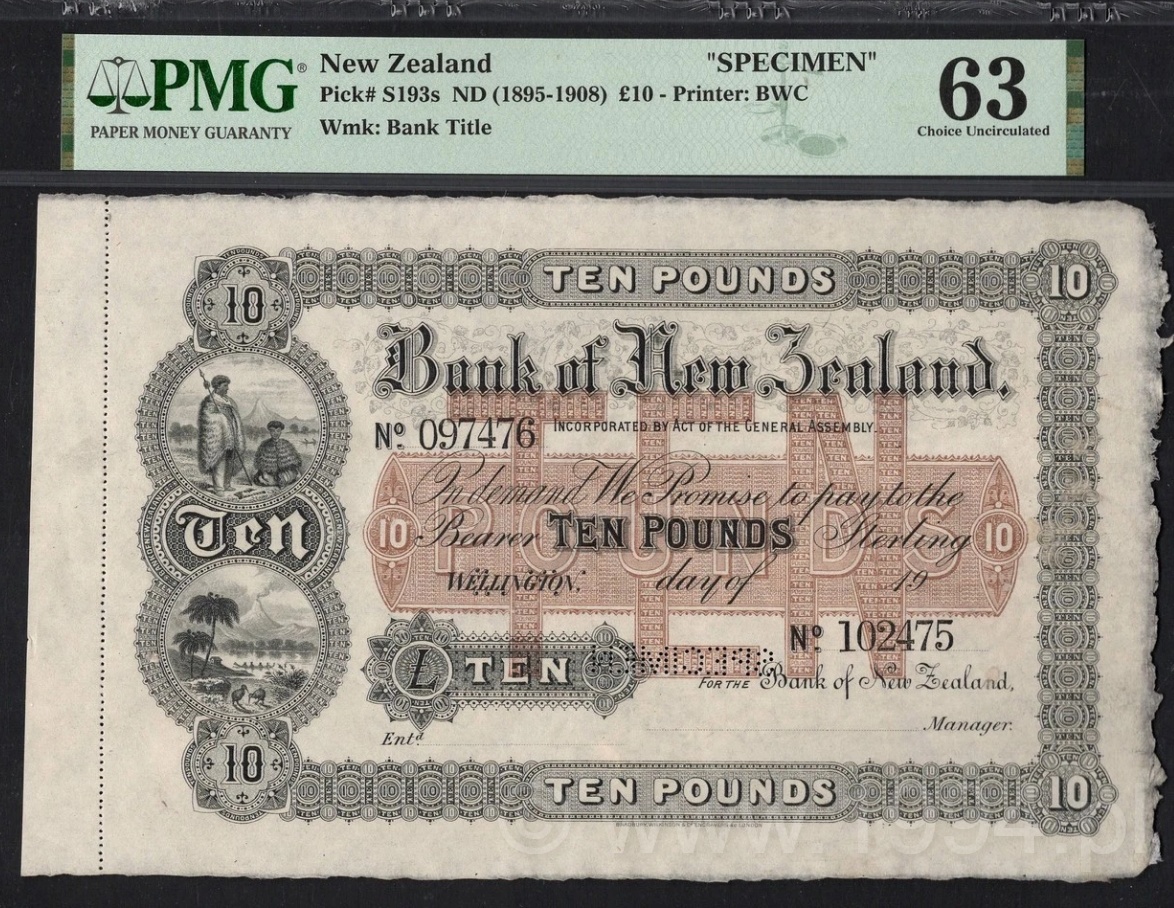
New Zealand 1895–1908 Bank of New Zealand 10 Pounds Brown specimen with dual serial numbers 097476 and 102475, perforated SPECIMEN, Bradbury Wilkinson printing, PMG 63 Choice Uncirculated

New Zealand 1895–1908 — Bank of New Zealand 10 Pounds Brown Specimen with Serial Number Prefix (Pick S193bs)

A high-denomination specimen from the Bank of New Zealand color lineage, the ten pounds brown (Pick S193bs) represents the serial-prefix approval format bearing dual printed control numbers, 097476 at upper left and 102475 at lower right. These serial-prefix specimens were produced for internal audit, plate approval, and archival reference purposes, distinct from zero-serial specimen impressions. Engraved and printed in London between 1895 and 1908 by Bradbury, Wilkinson & Company, Limited, the note reflects mature late-Victorian engraving practice. ... Read more →

New ZealandSpecimen with Serial Number Prefix189510 PoundsPMG 63 Choice Uncirculated Specimen10 PoundsBrownBNZ Color LineageSerial Prefix Specimen097476102475Perforated SPECIMENBradbury WilkinsonBWCPick S193bsBank of New ZealandPrivate Banknote EraPre-Reserve BankNew Zealand Banking HistoryMāori Portrait SeriesVictorian Edwardian TransitionSecurity Printing HistoryOceania NumismaticsHistoryNew Zealand189519081895-1908PMG 63Choice UncirculatedMuseum GradeR8 Extremely Rare
Held
New Zealand 1913 Bank of New Zealand £5 Orange multi-serial approval specimen Pick S192ms with serials 286901 and 296900, Bradbury Wilkinson & Co., PMG 63 Choice Uncirculated

New Zealand 1913 — Bank of New Zealand £5 Orange Multi-Serial Approval Specimen (Pick S192ms)

A numbered approval specimen of the Bank of New Zealand £5 Orange design, printed by Bradbury Wilkinson & Co., London, circa 1913. Though derived from the original 1895 S192 plate, this example bears two distinct serial numbers (286901 and 296900), identifying it as a multi-serial approval specimen drawn from the opening and closing positions of a controlled production range. Such pieces were created for printer audit, plate verification, and contractual record-keeping rather than circulation. ... Read more →

New ZealandSpecimen19135 PoundsPMG 63 Choice Uncirculated (Top Pop) Specimen5 PoundsOrangeBNZ Color LineageMulti-Serial ApprovalBradbury WilkinsonBWCPick S192msBank of New ZealandPrivate Banknote EraPre-Reserve BankNew Zealand Banking HistoryWWI-Era ProductionVictorian-Edwardian TransitionMāori Portrait SeriesMaritime Economy NotesSecurity Printing HistoryOceania NumismaticsNew Zealand1913PMG 63Museum GradeR8 Extremely Rare
Held
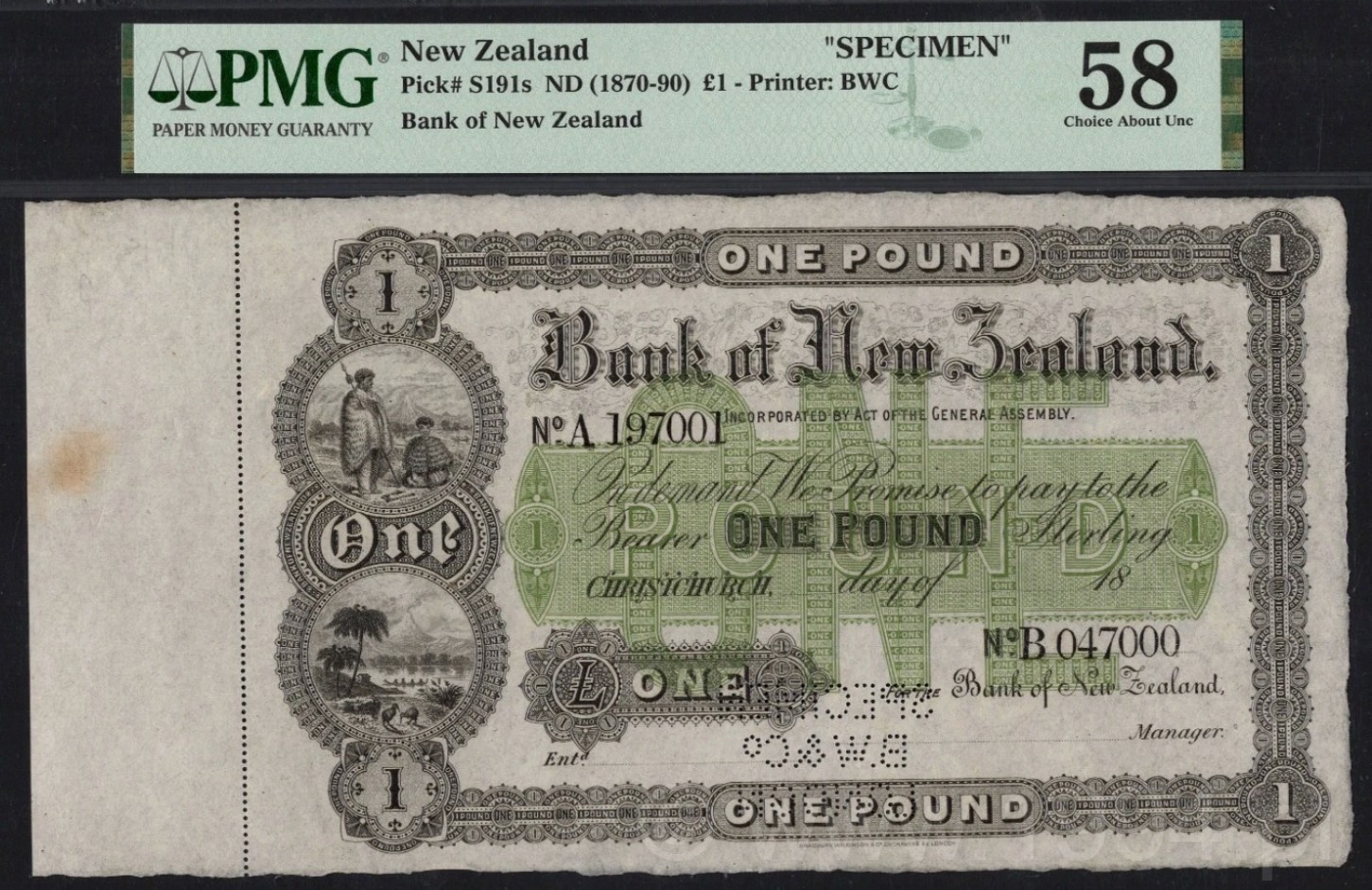
New Zealand 1870–1890 Bank of New Zealand 1 Pound Green Specimen Pick S191s, dual serial numbers A197001 and B047000, perforated CANCELLED, Bradbury Wilkinson printing, PMG 58 Choice About Uncirculated

New Zealand 1870–1890 — Bank of New Zealand £1 Green Specimen (Pick S191s)

The first Bank of New Zealand specimen and the foundation of the country’s pre-Reserve Bank note lineage. Engraved and printed by Bradbury, Wilkinson & Company, Limited, London, this one pound green specimen (Pick S191s) established the visual architecture reused throughout all later BNZ issues: paired Māori figures at left, an engraved coastal vignette below, and an ornate duty-tint panel framing the ONE POUND denomination. This design became the structural and visual origin of the Bank of New Zealand color lineage that defined New Zealand’s early commercial-bank currency. ... Read more →

New ZealandSpecimen18701 PoundPMG 58 Choice About Uncirculated Specimen1 PoundBank of New ZealandBradbury WilkinsonBWCDual Serial NumbersA197001B047000Perforated CANCELLEDAudit MarginPrinter Control SystemColonial IssueVictorian DesignMāori Portrait SeriesEngraved Security PrintingNew Zealand Banking HistoryPrivate Banknote EraPre-Reserve BankBNZ Color LineageColor Lineage Origin19th Century OceaniaMaritime Economy NotesEarly Indigenous ImageryBritish Colonial FinanceHistoryNew Zealand187018901870–1890Pick S191sPMG 58Choice About UncirculatedMuseum GradeR7 Extremely Rare
Held
New Zealand 1895–1915 Bank of New Zealand 5 Pounds Orange Specimen Pick S192s with dual serial numbers A000001 and A020000, perforated CANCELLED marking, left audit margin, and dated top margin printer annotations, printed by Bradbury Wilkinson & Company, Limited, London, PMG 55 About Uncirculated.

New Zealand 1895–1915 — Bank of New Zealand 5 Pounds Orange Specimen (Pick S192s)

The high-denomination anchor of the Bank of New Zealand color series, this five pounds orange specimen (Pick S192s) represents one of the most structurally complex and production-informative notes of New Zealand’s private banking era. Printed by Bradbury, Wilkinson & Company, Limited, London, it embodies the transition from richly ornamental Victorian engraving toward the more controlled and symmetrical Edwardian framework that followed. The composition preserves the defining elements of the earlier series—paired Māori figures within oval medallions at left, a lower maritime vignette reflecting colonial trade identity, and a dense guilloche lattice enclosing the denomination—while introducing a more disciplined spatial hierarchy across the central obligation panel. ... Read more →

New ZealandSpecimen18955 PoundsPMG 55 About Uncirculated Specimen5 PoundsBank of New ZealandBradbury WilkinsonBWCA Prefix SpecimenA000001A020000Dual Serial NumbersPrinter Control NumberingPerforated CANCELLEDAudit Margin LeftPrinter AnnotationsTop Margin AnnotationDated Annotation 1915Printer Ledger MarkingsColonial IssueHigh DenominationEdwardian DesignMāori Portrait SeriesEngraved Security PrintingNew Zealand Banking HistoryPrivate Banknote EraPre-Reserve BankBNZ Color LineageVictorian to Edwardian TransitionMaritime Economy NotesBritish Colonial FinanceSecurity Printing HistoryOceania NumismaticsHistoryNew Zealand189519151895-1915Pick S192sPMG 55Museum GradeR7 Extremely Rare
Held
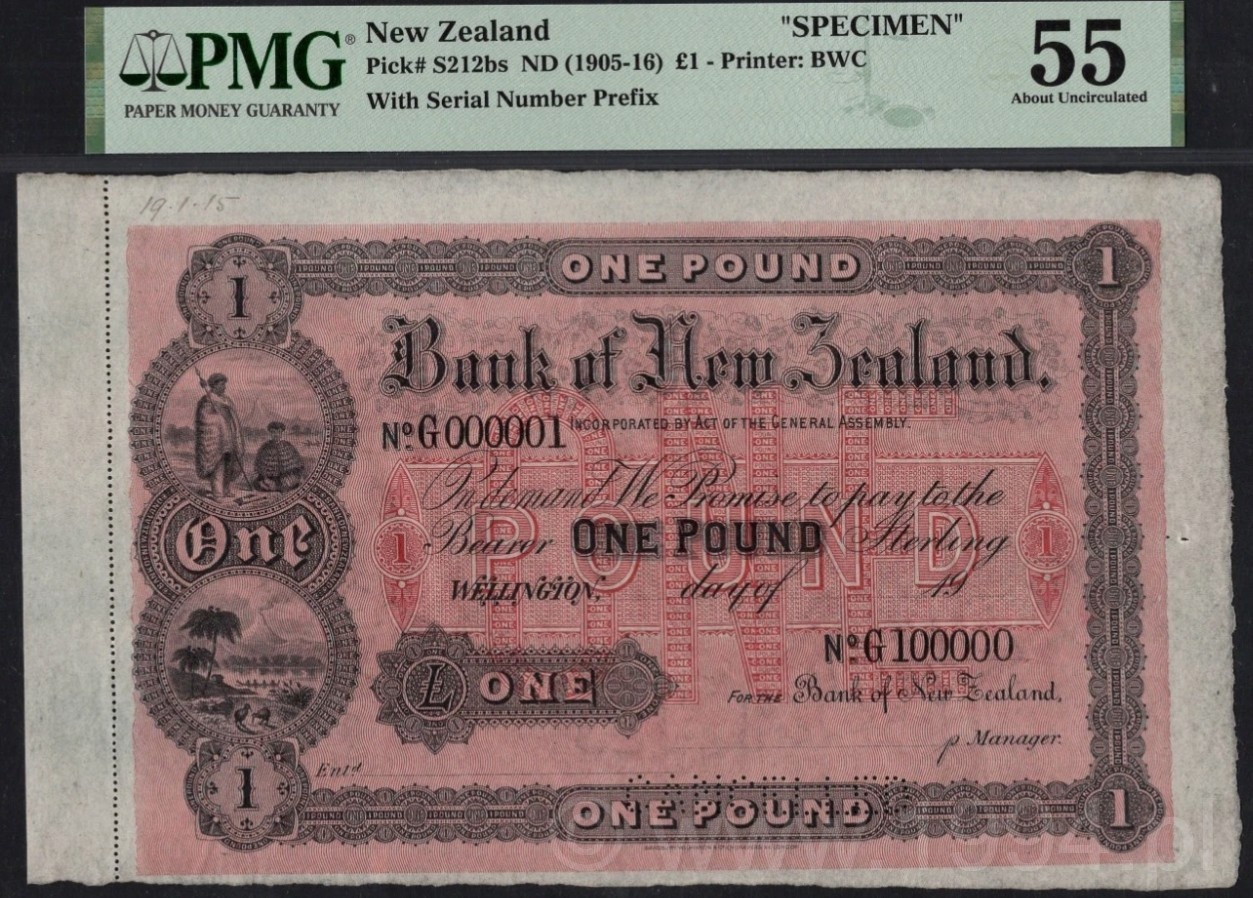
New Zealand 1905–1916 Bank of New Zealand £1 Red Pick S212bs, serial prefix G000001–G100000, perforated CANCELLED, Bradbury Wilkinson & Co., PMG 55 AU

New Zealand 1905–1916 — Bank of New Zealand £1 Red Cancelled Specimen with Serial Number Prefix G000001–G100000 (Pick S212bs)

An archival £1 Red specimen from the Bank of New Zealand private-issue series, catalogued as Pick S212bs and drawn from the opening serial block G000001–G100000. This example was pulled directly from the working plates of Bradbury Wilkinson & Co., London, as an approval and control specimen for internal printer and bank-director reference during the closing phase of BNZ private note production. The presence of live production serial numbers with the letter prefix G clearly distinguishes this class from unnumbered file specimens. ... Read more →

New ZealandSpecimen with Serial Number Prefix19051 PoundPMG 55 About Uncirculated Specimen1 PoundRedBNZ Color LineageSerial-Prefix VarietyCancelledBradbury WilkinsonBWCPick S212bsBank of New ZealandPrivate Banknote EraPre-Reserve BankWartime ProductionPrefix Block SequenceMāori Portrait SeriesSecurity Printing HistoryNew Zealand190519161905–1916PMG 55Museum GradeR8 Extremely Rare
Held
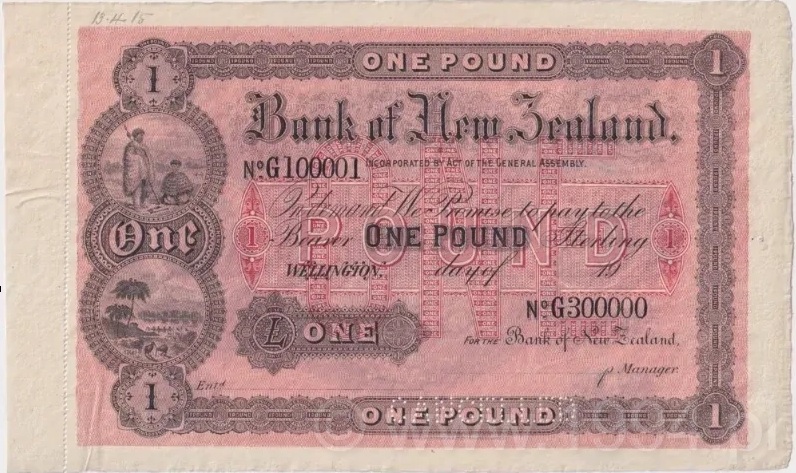
New Zealand 1905–1916 Bank of New Zealand £1 Red Pick S212bs, serial prefix G100001–G300000, perforated CANCELLED, Bradbury Wilkinson & Co.

New Zealand 1905–1916 — Bank of New Zealand £1 Red Cancelled Specimen with Serial Number Prefix G100001–G300000 (Pick S212bs)

Numbered specimen from the G100001–G300000 block of the BNZ £1 Red (Pick S212bs), printed by Bradbury Wilkinson & Co., London. Fully executed in final inks with live production numbering and perforated CANCELLED across the signature panel, identifying it as a printer-archive invalidation of a fully finished note rather than a proof or unfinished file copy. This cancelled variant represents the second major production block of the BNZ £1 Red sequence. ... Read more →

New ZealandSpecimen with Serial Number Prefix19051 PoundRaw (Serial-numbered Specimen, cancelled) Specimen1 PoundRedBNZ Color LineageSerial-Prefix VarietyCancelledBradbury WilkinsonBWCPick S212bsBank of New ZealandPrivate Banknote EraPre-Reserve BankWartime ProductionPrefix Block SequenceMāori Portrait SeriesSecurity Printing HistoryNew Zealand190519161905–1916Museum GradeR8 Extremely Rare
Held
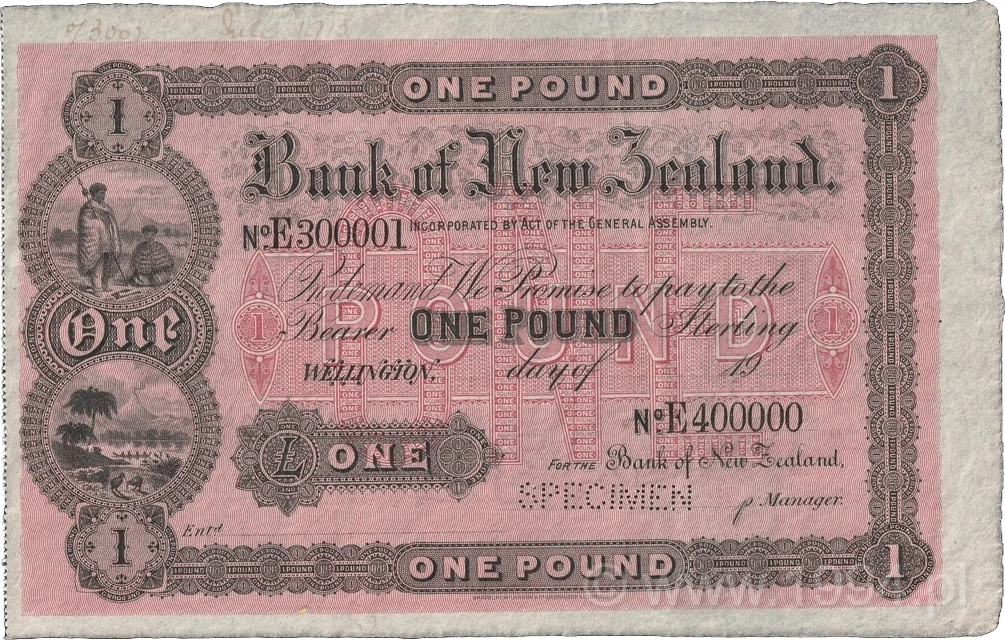
New Zealand 1905–1916 Bank of New Zealand £1 Red Pick S212bs, serial prefix E300001–E400000, perforated SPECIMEN, Bradbury Wilkinson & Co.

New Zealand 1905–1916 — Bank of New Zealand £1 Red Cancelled Specimen with Serial Number Prefix E300001–E400000 (Pick S212bs)

Numbered specimen from the terminal E300001–E400000 block of the BNZ £1 Red (Pick S212bs), printed by Bradbury Wilkinson & Co., London. Perforated SPECIMEN across the signature panel and preserved with wide selvage, this pull represents the final and rarest stage of BNZ £1 Red archival production. The E-prefix rollover marks a distinct late-WWI production phase involving plate recalibration and alphabetic reset within Bradbury Wilkinson’s numbering system. ... Read more →

New ZealandSpecimen with Serial Number Prefix19051 PoundRaw (Serial-numbered Specimen, wide selvage) Specimen1 PoundRedBNZ Color LineageSerial-Prefix VarietyE-prefixBradbury WilkinsonBWCPick S212bsBank of New ZealandPrivate Banknote EraPre-Reserve BankWartime ProductionPrefix Block SequenceMāori Portrait SeriesSecurity Printing HistoryNew Zealand190519161905–1916Museum GradeR8 Extremely Rare
Held
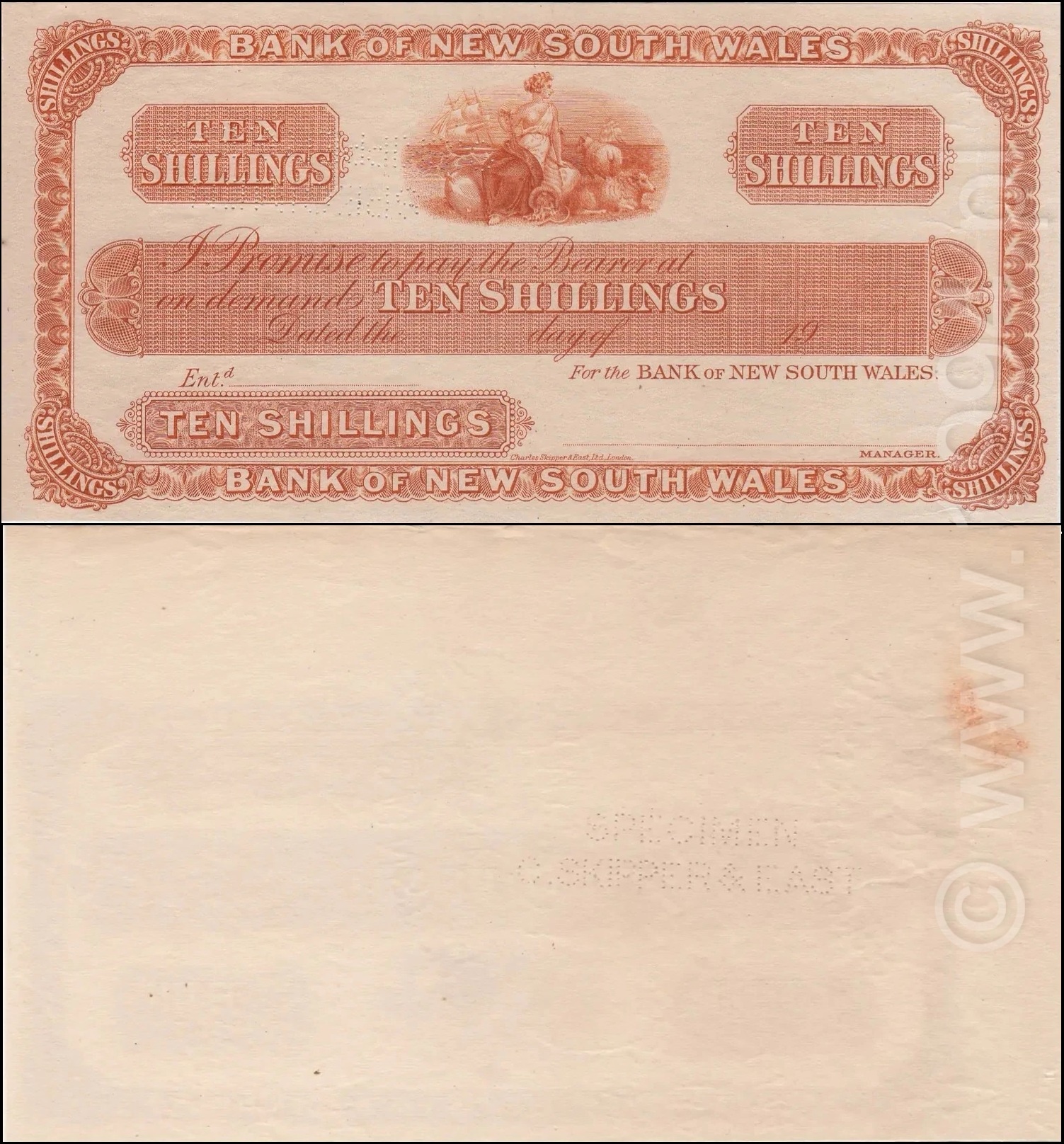
New Zealand ND 1924-1933 Bank of New South Wales ten shillings proof printed by Charles Skipper and East, perforated SPECIMEN control marking, single sided with blank reverse

New Zealand ND (1924-1933) - Bank of New South Wales Ten Shillings Proof, Perforated SPECIMEN (Pick S161s)

Printers archival proof for the Bank of New South Wales Ten Shillings, classified in the Standard Catalog and grading records as New Zealand Pick S161s (ND 1924-1933) and produced in London by Charles Skipper and East. This piece was never intended for circulation. It was created as part of the printers internal proofing, approval, and archival process and survives as a workshop original documenting the final approved design for a denomination that ultimately never entered public issue. ... Read more →

New ZealandProof192410 ShillingsChoice Uncirculated Proof Banknote10 ShillingsPrinter ProofPerforated SPECIMENPrinter Control MarkingNon Circulating ProofBank of New South WalesColonial BankingAustralasian BankingCharles Skipper and EastLondon Security PrintingGuilloche EngravingMicroletteringBlank ReverseNew ZealandND 1924-193319241933Pick S161sPick S161Museum GradeR8 Extremely Rare
Held
New Zealand ND 1924-1933 Bank of New South Wales ten shillings oversized proof printed by Charles Skipper and East, perforated SPECIMEN control marking, untrimmed margins, blank reverse

New Zealand ND (1924-1933) - Bank of New South Wales Ten Shillings Oversized Proof, Perforated SPECIMEN (Pick S161s)

Printers archival oversized proof for the Bank of New South Wales Ten Shillings, classified in the Standard Catalog and grading records as New Zealand Pick S161s (ND 1924-1933) and produced in London by Charles Skipper and East. This example survives on an oversized, untrimmed sheet and represents the most internal and earliest preserved production state of the design. Although cataloged under New Zealand, the design belongs to the broader Australasian operating structure of the Bank of New South Wales, a trans Tasman institution active in both Australia and New Zealand. ... Read more →

New ZealandProof192410 ShillingsChoice Uncirculated Proof Banknote10 ShillingsOversized ProofPrinter Archive ProofPerforated SPECIMENPrinter Control MarkingNon Circulating ProofUntrimmed MarginsBlank ReverseBank of New South WalesColonial BankingAustralasian BankingCharles Skipper and EastLondon Security PrintingGuilloche EngravingMicroletteringNew ZealandND 1924-193319241933Pick S161sMuseum GradeR9 Extremely RareUnique
Held
↑ Top