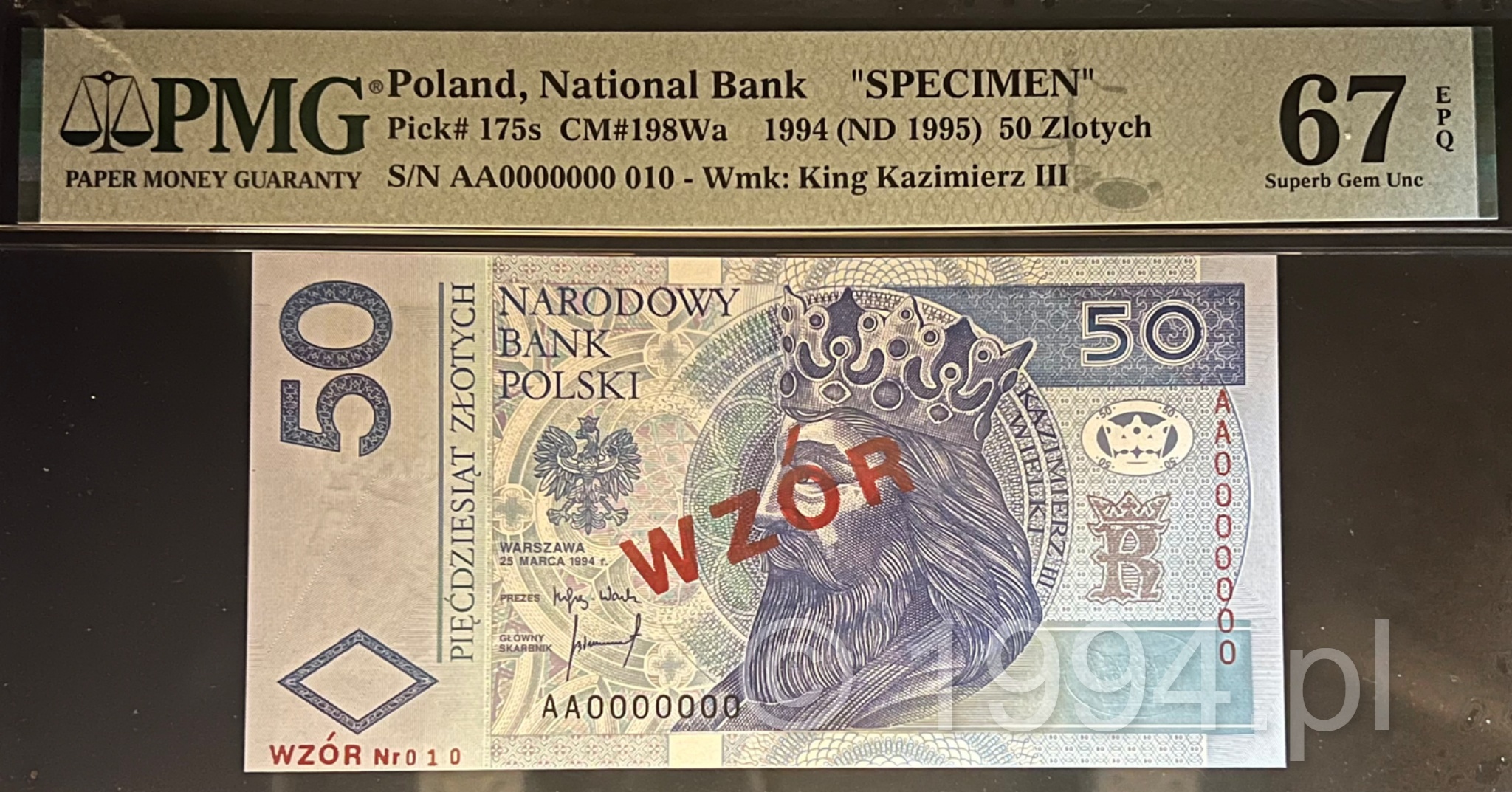
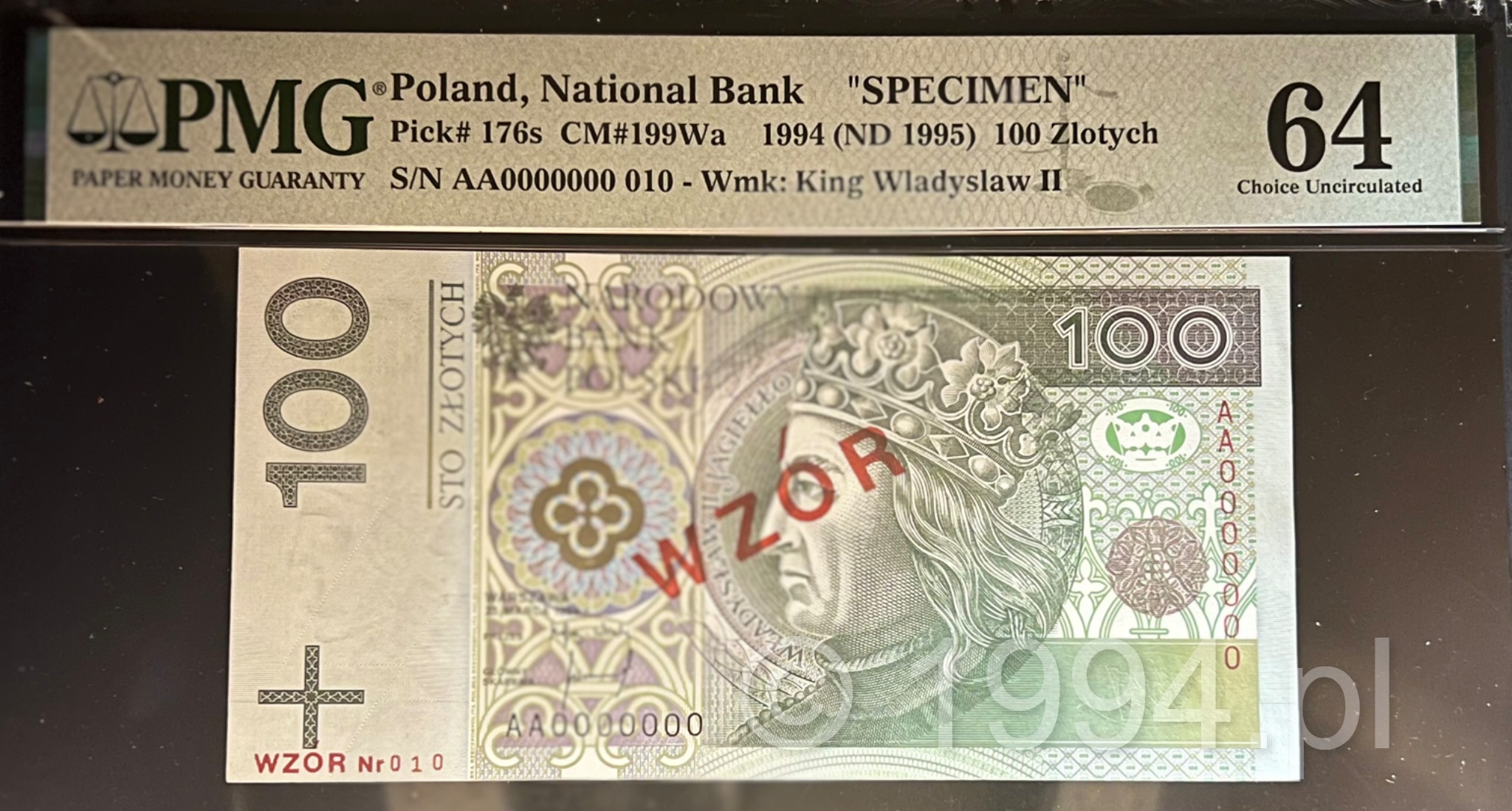
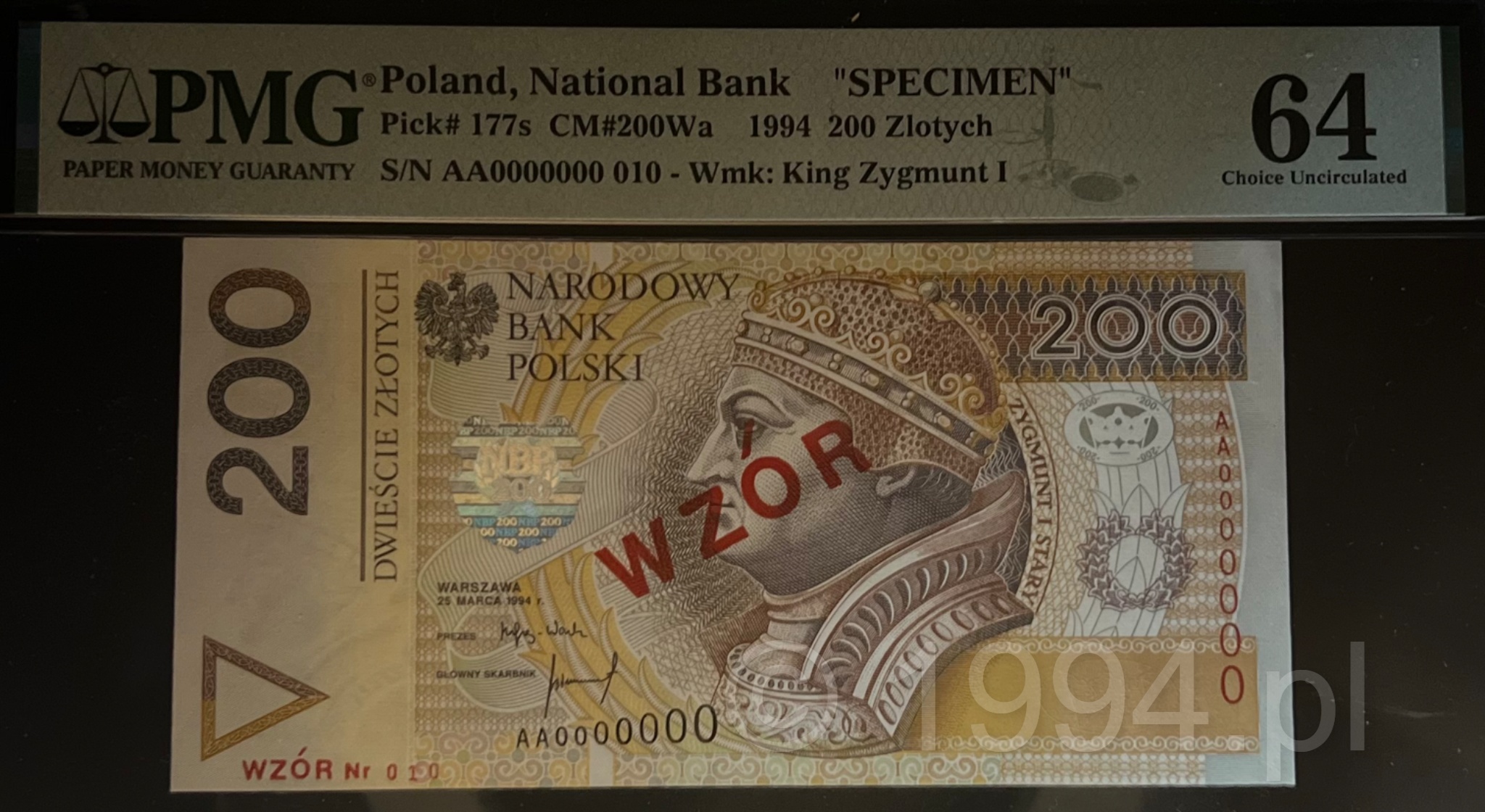
Poland 1994 - 50 Zlotych, Narodowy Bank Polski WZÓR Specimen Number 010 (Pick 175s)
The banknote was designed by Andrzej Heidrich and printed by Thomas De La Rue in London for the National Bank of Poland. Read more →
The obverse design presents an engraved portrait of José Gervasio Artigas, Uruguay’s foundational national figure, rendered within an ornate architectural framework characteristic of Thomas De La Rue and Company’s late-interwar intaglio production. The denomination MIL PESOS dominates the central cartouche, emphasizing the note’s position at the apex of the denomination hierarchy. This example belongs to the Series A–B grouping and bears a controlled all-zero serial format, consistent with non-circulating specimen preparation. Read more →
The imprint of Thomas De La Rue and Company Limited appears at the lower center of the reverse. The London security printer combined portrait engraving, architectural framing, fine-line backgrounds, watermark integration, and repeated denomination devices into a design capable of expressing both high monetary value and official state authority. Read more →
The specimen-control system is visually decisive. A diagonal red SPECIMEN inscription crosses the obverse from lower left toward upper right. Red oval Thomas De La Rue specimen stamps are applied over the upper-left area and the lower-right corner. At the lower margin, the designation SPECIMEN No. 2 is printed in red, preserving the note's exact place within the distribution sequence. Read more →
The obverse design features the engraved portrait of José Gervasio Artigas, Uruguay’s foundational national figure, executed within an ornate architectural framework characteristic of Thomas De La Rue and Company’s late-interwar intaglio production. The denomination MIL PESOS dominates the central cartouche, underscoring the note’s position at the apex of the denomination hierarchy. This example belongs to the Series A–B grouping and bears a controlled all-zero serial format, accompanied by the printed designation SPECIMEN No. 50 at the lower left margin, confirming its place within a numbered specimen sequence. Read more →
Printed by Thomas De La Rue and Company Limited, this specimen records a specialized method of controlling high-value reference currency. Its importance lies not only in the five hundred pesos design itself, but in the survival of a distinct administrative format in which perforation, rather than printed ink, served as the permanent instrument of cancellation. It is a complete production-standard record of the Serie A type and a significant document of the security printer's institutional handling practices. Read more →
Numbered Specimen No. 29, this Serie A five hundred pesos note was prepared as a formally identified reference example of the Banco de la Republica Oriental del Uruguay issue authorized under the law of 2 January 1939. Its combination of all-zero serial numbers, a printed specimen number, a diagonal red SPECIMEN inscription, and a Thomas De La Rue control stamp places it within a managed distribution sequence rather than an anonymous archive group. Read more →
The obverse is built around a deliberately conservative composition typical of late twentieth century Thomas De La Rue and Company Limited output for British overseas territories. Queen Elizabeth the Second appears at right in a dense engraved portrait field designed to anchor the note’s authority visually and to concentrate anti-counterfeiting linework in a single high-information zone. At center, the Cayman Islands coat of arms is integrated into a bold denomination panel reading One Dollar, a layout that privileges immediate denomination recognition while preserving an uncluttered field for security patterning. Beneath the central panel, the note bears the engraved signature of A. Jefferson, serving as Chairman of the Cayman Islands Currency Board at the time of this printing. The printed serial number 105218 with prefix A/6 occupies the left and right serial positions, providing the operational identity of this specific note within the printed run. Read more →
The obverse follows a restrained and highly structured layout characteristic of Thomas De La Rue and Company Limited’s work for British overseas territories during the late twentieth century. A formal engraved portrait of Queen Elizabeth the Second occupies the right half of the note, concentrating fine-line security engraving in a high-density visual field. At center, the Cayman Islands coat of arms is integrated into the principal denomination panel reading One Dollar, establishing immediate denomination clarity while reinforcing institutional authority. Beneath this panel appears the engraved signature of A. Jefferson, serving as Chairman of the Cayman Islands Currency Board at the time this printing was produced. Read more →
This specimen note represents the one dollar denomination prepared for the Cayman Islands Currency Board under the Cayman Islands Currency Law of 1974 and was printed by Thomas De La Rue and Company Limited, with the PMG label attributing the production to a not dated 1981 printing. It was produced as a presentation and reference specimen and was never intended for public circulation, reflecting an earlier administrative phase within the Currency Board’s handling of the 1974 series. Read more →